




Quantum sensors enable multitasking measurement of multiple properties simultaneously, improving precision and unlocking advanced sensing applications in science.
Quantum sensors are emerging as powerful tools capable of detecting extremely small signals that traditional technologies cannot capture. Hence, researchers at Massachusetts Institute of Technology have developed a new approach that allows quantum sensors to measure multiple physical properties simultaneously, marking a significant step toward practical, real-world applications.
Solid-state quantum sensors have gained attention for their versatility in fields such as biomedical research and materials science. However, a major limitation has been their inability to measure more than one parameter at a time. When multiple properties, such as magnetic field and temperature, are measured together, their signals tend to interfere, reducing accuracy.
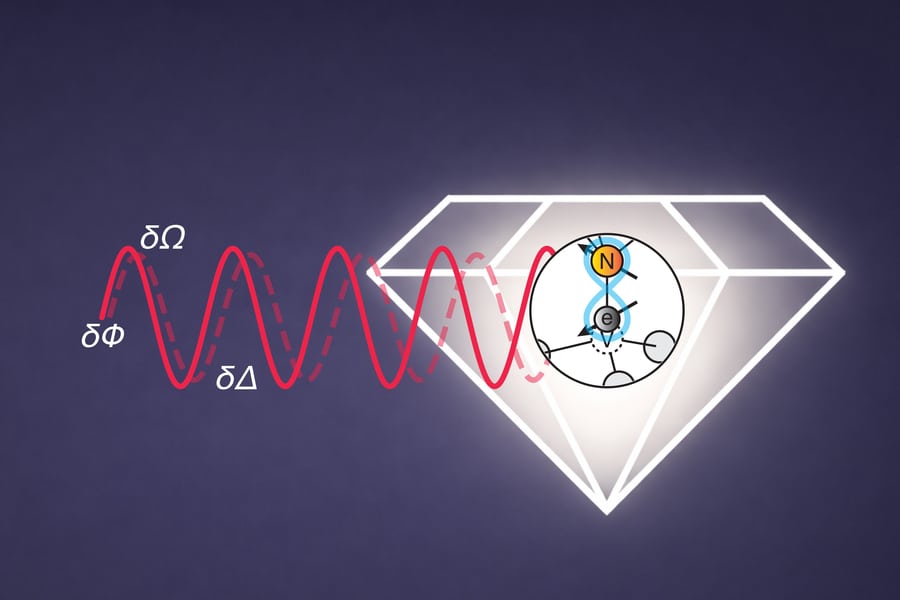
The researchers overcame this challenge by leveraging quantum entanglement, a phenomenon where particles become interconnected and share a single quantum state. Using this principle, they demonstrated a system capable of measuring multiple parameters, specifically the amplitude, frequency, and phase of a microwave field, in a single experiment.
At the core of the system are nitrogen-vacancy centers embedded in diamonds. These microscopic defects are highly sensitive to external influences like magnetic fields and temperature. By using two quantum bits (qubits) derived from these defects, the researchers were able to expand the number of measurable outcomes beyond the binary limits of a single qubit.
The technique relies on a method known as Bell state measurement, which enables simultaneous extraction of multiple parameters. While previous experiments demonstrated similar concepts under extremely low temperatures, the team successfully implemented this method at room temperature, making it far more practical for real-world applications.
This breakthrough has important implications. By enabling multitasking measurements, quantum sensors can provide deeper insights into complex systems, such as tracking molecular activity in living cells or studying atomic behavior in advanced materials. It also reduces the need for repeated experiments, improving both efficiency and accuracy.


