

Reusable simulation environments, robot-training pipelines and deployment frameworks give design engineers a starting point for developing and validating AI-powered robotic systems.
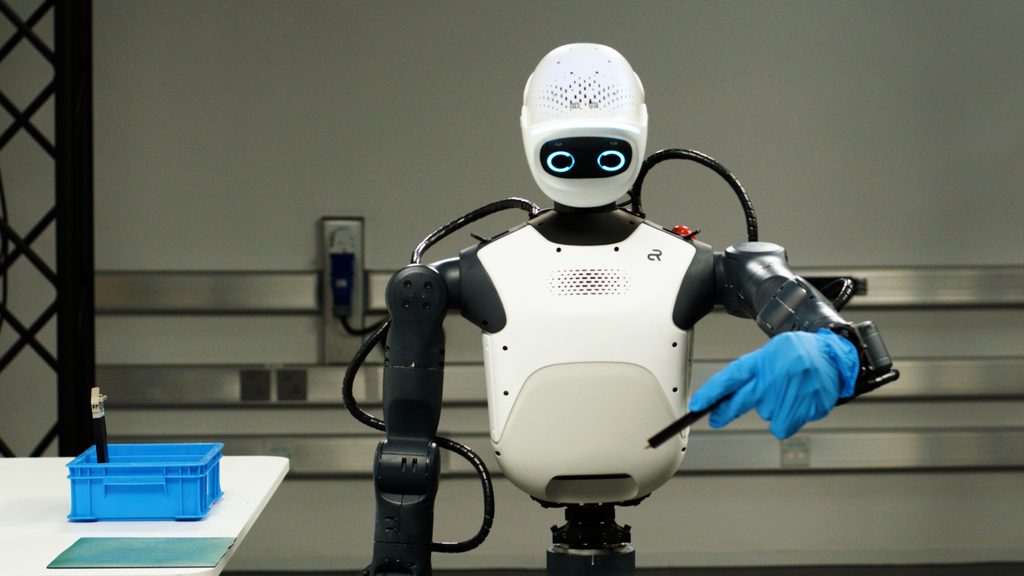
NVIDIA has expanded its Isaac robotics platform with reference workflows, simulation assets, training datasets and deployment software that design engineers can adapt when developing general-purpose robots. Rather than a ready-to-build electronic circuit, this reference design approach provides reusable software frameworks and development workflows for building, training and testing robotic systems. Engineers can use these resources as a starting point for humanoid robots, autonomous mobile robots and industrial automation equipment, reducing the need to develop simulation environments and AI-training pipelines from scratch.
The core development framework, NVIDIA Isaac Lab 3.0, supports robot-control training through reinforcement learning and physics simulation. It uses physics engines such as Newton and NVIDIA PhysX and supports multi-GPU workflows. Engineers can adapt these capabilities to train locomotion, grasping and manipulation behaviours, evaluate robot responses to physical interactions, and identify control issues in simulation before transferring trained policies to physical hardware. This makes the framework useful during the early design and validation stages, when teams need to compare control approaches without repeatedly testing them on expensive prototypes.
For simulation environment development, the SimReady Central Library provides more than 2,000 simulation-ready assets. Engineers can use these assets to build virtual factories, workspaces and equipment layouts for testing navigation, object handling and human-robot interactions. The Human 1M Dataset, comprising videos of human activities captured from three synchronised views and 3D hand-tracking data, can support the development of robotic systems that learn manipulation skills from human movements. These resources provide reusable starting points for preparing virtual environments and training data.
NVIDIA has also introduced three reference workflows for its DGX Station computing system. These cover reinforcement learning to refine GR00T 1.7 models, training dexterous manipulation skills in Isaac Lab, and post-training NVIDIA Cosmos world models for synthetic-data generation. Design engineers can use the workflows as baseline pipelines, modify training parameters for their target applications, and evaluate performance before deployment.
For system integration, NVIDIA Isaac OS provides an open-source runtime framework built on NVIDIA Holoscan to connect AI, sensors, control software and robot hardware. NVIDIA Halos supports safety development and validation for autonomous systems. These resources help engineers plan the transition from simulated behaviour to real-time robotic operation.
For humanoid development, Agile Robots has announced the Agile ONE SN reference platform, combining NVIDIA Isaac GR00T with the Jetson Thor edge AI platform, multimodal sensors and dexterous hands. Availability is planned for early 2027.
Engineers can select the relevant simulation assets, training workflow and runtime framework, then integrate them with suitable processors, sensors, motor drives, communication interfaces and power-management circuitry. The resources are particularly applicable to humanoid robots, warehouse automation and industrial manipulators. They do not replace hardware design or application-specific safety validation; instead, they provide a reusable software reference that can shorten development and testing cycles.
NVIDIA provides supporting development resources for its Isaac robotics reference workflows, including simulation environments, robot-learning frameworks, training datasets and software tools. These resources help design engineers develop, train and validate robotic behaviours before deployment on physical hardware. Unlike a conventional electronic reference design, the platform does not provide a complete PCB layout, schematic or bill of materials (BOM); engineers must select and integrate hardware components according to their application requirements. For more details, click here.