A miniature resonator-based chip improves AI-driven wireless communication systems by enhancing signal efficiency, reducing power loss, and enabling faster data exchange for edge devices and next-generation IoT networks.

Researchers at the Korea Advanced Institute of Science and Technology (KAIST) have developed a miniature resonator-based chip designed to improve how AI systems handle wireless communication, particularly in edge devices and dense IoT networks. The technology focuses on improving signal stability and reducing energy loss, addressing a key bottleneck in modern AI-driven connectivity systems.
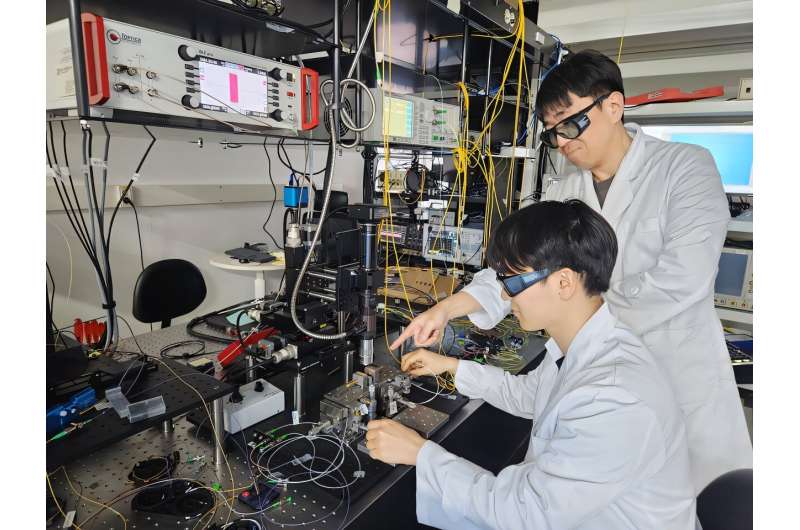
The chip uses microscopic resonant structures that precisely control electromagnetic signals on the hardware level. By tuning how signals are generated, filtered, and transmitted, the resonator enables cleaner frequency selection and reduces interference in crowded wireless environments. This allows AI models embedded in devices to communicate more efficiently without requiring higher power consumption.
Unlike conventional RF components that rely on larger and more power-intensive circuitry, the resonator chip integrates signal processing directly into a compact architecture. This reduces latency between transmission and processing, which is particularly important for real-time applications such as autonomous systems, smart sensors, and industrial automation.
In laboratory demonstrations, the system showed improved spectral efficiency and more stable signal propagation across varying network conditions. Researchers noted that the design is particularly suited for next-generation communication standards, where devices must continuously exchange data while operating under strict energy constraints.
The advancement also aligns with growing demand for edge AI, where computation is performed locally rather than in centralized cloud servers. By enabling faster and more reliable communication at the hardware level, the resonator chip reduces dependency on large-scale infrastructure and supports distributed intelligence across devices.
Engineers highlight that the compact design could be integrated into future AI chips without major changes to existing semiconductor manufacturing processes. This makes it a strong candidate for scaling in consumer electronics, smart infrastructure, and industrial IoT systems.
As wireless networks become more congested with billions of connected devices, such resonator-based architectures may play a key role in maintaining performance while keeping power consumption low. The approach represents a shift toward combining AI computation and communication efficiency at the chip level, rather than optimizing them separately.