A four-legged robot learns to run, adjust its path and jump through narrow openings using motion data and onboard vision.
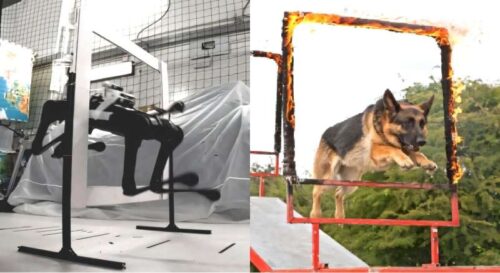
Researchers from the University of Hong Kong (HKU) and the Oxford Robotics Institute have developed a learning framework that enables a quadrupedal robot to detect a narrow gate, run towards it and jump through the opening autonomously.
The system was demonstrated on a 22-kg Aliengo robot. Using an RGB-D camera, the robot identifies the gate and adjusts its speed and direction before jumping. During the jump, it folds its legs to clear the gate frame and lands while continuing to run.
The researchers did not program the robot with instructions for when to jump or which legs to fold. Instead, the behaviour emerged through the learning process. The low-level controller learns movements from motion-capture data of a dog. The training covers pacing, cantering, steering and jumping. An adversarial imitation learning method helps the robot reproduce these movements.
A discriminator network evaluates whether the robot’s movements resemble those of the animal. Its assessment is incorporated into the training process, helping the robot learn movements based on animal motion.

The framework does not maintain separate skills for walking, running, jumping and landing. Instead, these movements can blend, allowing the robot to transition between them based on the required speed.
A high-level controller determines how the robot approaches the gate. It processes RGB-D camera data 10 times per second and produces two outputs: forward speed and turning rate. Rather than controlling every joint directly, it determines how fast the robot should move and in which direction. The researchers said the controller could be trained in about six hours.
During physical tests, the robot accelerated towards the gate, performed the jump and folded its legs to allow its feet to pass through the opening. It also adjusted its path when the gate position changed. For higher openings, it used a longer approach and folded its joints more. When the gate was positioned to one side, it crossed diagonally.
The movement skills can be reused for tasks such as jumping over hurdles, clearing fences and passing through constrained spaces without retraining the complete locomotion system.
The current system still uses external motion capture during training. The researchers plan to use onboard sensors and extend the framework to more constrained movements and humanoid robots.