Rover tests on Earth may give wrong results. Simulations show Earth’s gravity makes sand seem firm when it is loose on the Moon or Mars.
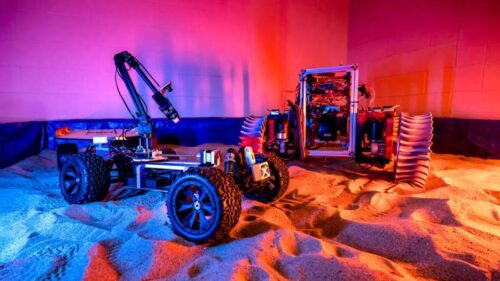
Mechanical engineers at the University of Wisconsin–Madison have identified a critical flaw in how planetary rovers are tested on Earth. Simulations show that Earth’s gravity makes sand appear more supportive than it actually is on the Moon or Mars, creating a false sense of rover performance and increasing the risk of failure during real missions.
The discovery came during a NASA-funded project simulating the VIPER rover, which is planned for a future lunar mission. The team used Project Chrono, an open-source physics simulation tool developed at UW–Madison in collaboration with international partners. Chrono models how full-sized vehicles behave on soft, shifting surfaces like sand or soil.
While simulating the rover, the team noticed clear differences between Earth-based test results and the rover’s behavior under moon-like conditions. Further analysis using Chrono revealed that the original testing method, which involves smaller rovers with one-sixth the mass being tested in Earth’s deserts, misses a key variable—Earth’s gravity acting on the sand.
On Earth, gravity pulls strongly on the sand, compacting it and making it more rigid and supportive. This provides better traction for rover wheels. But on the Moon, where gravity is one-sixth as strong, the surface is looser and shifts more easily. As a result, rovers are more likely to lose traction and get stuck—like NASA’s Spirit rover, which became permanently trapped in soft Martian soil in 2009.
To avoid similar incidents in future missions, researchers emphasize the need for more accurate terrain testing before launch. Simulation tools like Chrono help fill this gap by modeling low-gravity environments more realistically than physical Earth-based testing.
Beyond space applications, Chrono has been useful in modeling a wide range of Earth-based systems—from mechanical watches to military vehicles navigating rough terrain. Though it is free and publicly available, its development and maintenance require constant effort from the UW–Madison team.
The team takes pride in building industrial-grade software in an academic setting—something that’s uncommon, especially at the level required by space agencies. Chrono continues to evolve, with active development ensuring it remains a valuable tool for solving real-world engineering challenges, whether on Earth or other planets.