




Researchers made an electronic skin that feels touch, detects damage, repairs itself underwater, and works without batteries for robots, diving gear and wearable devices.
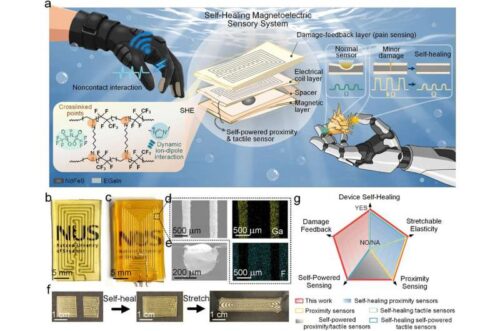
Researchers at the National University of Singapore (NUS) have developed an electronic skin that can detect touch, sense nearby objects, identify damage and repair itself underwater without an external power source. The system was tested in a diving glove for underwater communication and a robotic hand that continued working after being damaged.
The electronic skin combines touch sensing, proximity sensing, damage detection and self-repair in a single system. It also generates its own electrical signals, removing the need for batteries or an external power supply.
The device is made of multiple layers built on a stretchable material with liquid-metal conductors. The top layer detects damage, while another layer senses touch and nearby objects. When the surface is punctured or cut, its electrical resistance increases, allowing the system to detect the damage. The material then reconnects through reversible molecular bonds and restores its sensing function.
In laboratory tests, the sensor recovered its electrical performance within seconds after needle punctures. After larger cuts, light mechanical pressure started the repair process, and the sensor later regained full function. The material recovered up to 92 per cent of its elasticity and restored almost all of its sensing performance underwater after ten days.
The system produces electricity through electromagnetic induction. A magnet and a liquid-metal coil generate electrical signals when pressure is applied or when an object moves close to the sensor. This enables both touch and proximity sensing without an external power source.
The sensor responded in about 41 milliseconds, continued operating after 10,000 use cycles and maintained its sensing performance after ten days in simulated seawater.
The researchers integrated the technology into a diving glove with sensors on each fingertip. Different hand gestures generated electrical signals that were transmitted wirelessly to a smartphone. The glove recognised commands such as ‘Normal’, ‘Going up’, ‘Going down’, ‘Holding’ and ‘Help’. It also switched on red light emitting diodes (LEDs) when it detected major damage.
The team also fitted the electronic skin to a robotic hand for underwater handling tasks. During testing, the hand picked up and moved objects underwater while detecting puncture damage and recovering its sensing function.
The researchers said the technology could be used in underwater robots, electronic skin, prosthetic devices and other systems that need to continue operating after damage.


