
Amprius says its second-generation SiCore cell delivers 500 watt-hours per kilogram, with production cells expected in late 2026.
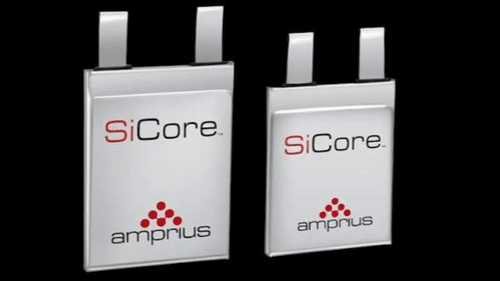
Amprius Technologies, a silicon-anode battery manufacturer based in Fremont, California, has introduced SiCore 500, a lithium-ion cell rated at 500 watt-hours per kilogram at a 1C continuous discharge rate. The cell is aimed at high-altitude platform stations, fixed-wing drones and other long-endurance uncrewed aircraft.
The key claim is not simply the 500 watt-hours per kilogram figure. Amprius says it has previously achieved that energy density using specialised manufacturing processes that were not intended for high-volume production. SiCore 500 is its first platform to reach that performance using conventional lithium-ion battery manufacturing equipment.
Conventional lithium-ion cells typically use graphite anodes. Graphite stores lithium between layers of carbon, limiting how much lithium the anode can hold per unit mass. Silicon can store substantially more lithium, but it expands significantly during charging, creating stresses that can damage the anode and shorten battery life.
Amprius uses a proprietary silicon-anode material system for SiCore. According to the company, the second-generation SiCore anode uses an ultra-fine silicon nanostructure with multilayer surface protection designed to manage expansion stress and reduce unwanted surface reactions. Unlike Amprius’s earlier SiMaxx platform, the SiCore architecture is designed to be processed using equipment and manufacturing environments similar to those used for conventional graphite anodes.
Initial production is planned at Amprius’s Fremont facility, with higher-volume manufacturing expected to scale through contract manufacturers. Commercial availability is expected from the fourth quarter of 2026. The company will offer customer-specific cell formats alongside a standard pouch-cell format for small uncrewed aircraft systems based on SAE JA1016.
In a fixed-wing aircraft, battery weight is a major factor in endurance. Higher specific energy means more stored energy can potentially be carried without increasing battery mass, extending flight time, range or payload capability. Pierre-Antoine Aubourg, chief operating officer of AALTO HAPS, said that energy density is fundamental to Zephyr’s endurance and that continued gains in specific energy can meaningfully extend flight duration and expand mission capability.
This is a production platform rather than a laboratory research result, but SiCore 500 has not yet entered commercial availability. Amprius expects the cell to become commercially available in the fourth quarter of 2026. Dr Ionel Stefan, chief technology officer at Amprius, said the use of conventional manufacturing equipment gives aviation customers a cost-effective and scalable path from qualification to volume production. The announcement does not identify a specific customer qualification programme for SiCore 500.
India’s drone industry currently relies heavily on imported lithium-ion cells, particularly for high-performance battery applications. The Production Linked Incentive scheme for Advanced Chemistry Cell battery storage is intended to expand domestic cell manufacturing, although aviation-grade cells with extremely high specific energy remain a specialised category.
For Indian drone manufacturers, the practical considerations would include cell availability, import costs, transport requirements and integration into aviation battery packs. Lithium-ion cells are regulated as dangerous goods during transport and must meet applicable testing, packaging and shipping requirements.
India has also pursued high-altitude and solar-powered aircraft research through organisations including CSIR-National Aerospace Laboratories in Bengaluru. A commercially available cell with 500 watt-hours per kilogram could be relevant to future long-endurance uncrewed aircraft programmes, although Amprius has not announced an Indian customer or integrator for SiCore 500.
Manufacturers importing or integrating such cells would also need to check the applicable Indian safety and certification requirements, including whether the specific cell and its intended application fall within the scope of standards such as IS 16046.
India’s drone sector depends heavily on imported battery cells for high-end applications. A production cell with this level of specific energy could ease an important endurance constraint, but its practical use would depend on availability, cost and the ability to meet India’s import, transport and certification requirements.
For more information, click here.