




KAIST researchers have built a silicon-based Ising machine using standard CMOS transistors, enabling ultra-fast optimisation computing for AI, semiconductor design, logistics, and network planning applications.
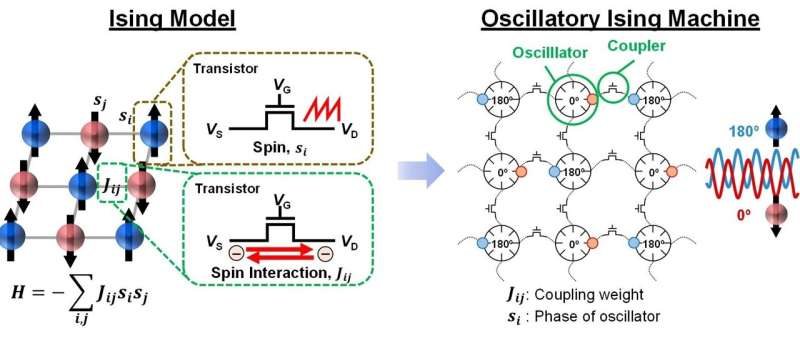
Researchers at KAIST have developed a silicon-based oscillatory Ising machine capable of solving complex optimisation problems that would take conventional semiconductor-based computers thousands of years to process. The system is built entirely using standard CMOS semiconductor technology, making it compatible with existing chip manufacturing infrastructure.
The research, published in Science Advances, addresses combinatorial optimisation problems—tasks involving massive numbers of possible combinations where the objective is to identify the most efficient solution. These problems are common in logistics routing, semiconductor layout design, communication networks, AI computing, and financial modelling.
Unlike conventional digital processors that rely on sequential computation, the KAIST system uses synchronised silicon oscillators. Multiple oscillators exchange electrical signals and naturally settle into their lowest-energy stable state, which corresponds to the optimal solution of a given problem. The approach is based on Ising machines, specialised computing architectures designed for optimisation workloads.
A key challenge in earlier oscillator-based Ising machines was maintaining precise frequency synchronisation between oscillators while scaling to larger problems. The KAIST team addressed this by implementing both oscillators and couplers using single silicon transistors. This reduced frequency variation and enabled finer multi-level coupling control, improving both scalability and computational accuracy.
The researchers demonstrated the hardware using the Max-Cut optimisation problem, a benchmark widely used in AI, network analysis, and semiconductor circuit placement. According to the team, the architecture could support faster decision-making in large-scale industrial applications while consuming far less energy than traditional high-performance computing systems.
Because the technology relies entirely on existing silicon fabrication processes, it does not require exotic materials or new manufacturing infrastructure. This significantly improves its commercialisation prospects compared to many experimental AI accelerators and quantum-inspired systems.
The researchers describe the work as a potential “third wave” of transistor evolution—moving beyond switching and amplification toward oscillation-driven computing architectures for future AI and semiconductor systems.
