The silicon PIN photodiode, with fast switching and low capacitance, is designed for wearable devices like fitness trackers and smartwatches, enhancing signal detection.
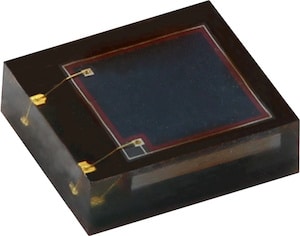
Vishay Intertechnology, Inc. has expanded its optoelectronics collection by unveiling a silicon PIN photodiode, the VEMD2704, with sensitivity to visible light. This device comes in a 2.0 mm by 1.8 mm by 0.6 mm top-view surface-mount package, using clear epoxy to enhance sensitivity. The VEMD2704 features a switching time of 70 ns and a capacitance of 17.6 pF, ensuring signal detection in wearable technology.
The photodiode has a radiant-sensitive area of 1.51 mm² and sensitivity with a reverse light current of 1.17 µA and a dark current of 0.03 nA. It can sense visible and near-infrared light across a spectrum ranging from 350 to 1100 nm. It is suitable for use in wearable devices like fitness trackers and smartwatches, where it can be paired with green LEDs for heart rate monitoring and red LEDs for blood oxygen level measurement through pulse oximetry.
Designed to be compact, the photodiode facilitates integration into devices such as earbuds. It allows the inclusion of multiple photodiodes within the optical system for signal detection accuracy and offers flexibility in sensor positioning. Additionally, the VEMD2704 is cost-effective, making it an option for products like smart bands.
Some of the key features of the photodiode include:
- Reverse voltage: 6V
- Ambient temperature range: -40 to +85 °C
- Storage temperature range: -40 to +85 °C
- Soldering temperature: 260 °C
- ESD safety: ≥ 2 kV
Specifications of the PIN photodiode include a ±67° angle of half-sensitivity, an operational temperature range of -40 °C to +85 °C, and peak sensitivity at a wavelength of 940 nm. It complies with RoHS, is halogen-free, adheres to Vishay’s Green standards, and has a moisture sensitivity level (MSL) of 3 per J-STD-020, allowing a floor life of 168 hours.