




A dual-core chip supports multiple network standards, displays, cameras, audio, and AI processing in one device.
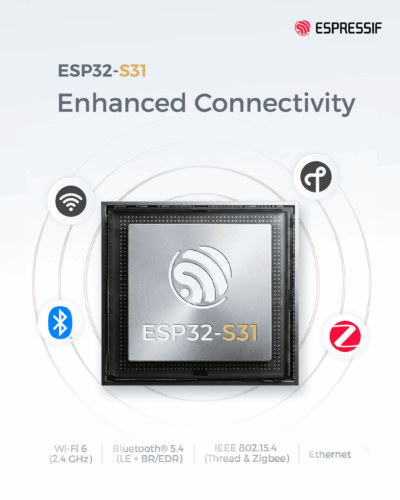
Espressif has expanded its ESP32 portfolio with the ESP32-S31, a new dual-core RISC-V SoC that combines Wi-Fi 6, Bluetooth 5.4, IEEE 802.15.4, and Gigabit Ethernet connectivity in a single device. The chip is aimed at IoT products that require support for multiple networking standards, local AI processing, multimedia functions, and user interfaces.
The SoC supports Wi-Fi, Bluetooth, Thread, Zigbee, Matter, and Ethernet, allowing developers to build devices that can communicate across smart-home and industrial networking ecosystems without relying on multiple chips. This combination targets applications such as smart appliances, home hubs, voice-controlled devices, industrial automation equipment, and connected multimedia systems.
At the processing level, the ESP32-S31 integrates a dual-core 32-bit RISC-V microcontroller running at up to 320 MHz. One of the cores features a 128-bit SIMD data path designed to accelerate parallel data processing, making the device suitable for edge AI and multimedia workloads. The SoC also supports external DDR PSRAM and multiple SPI memory interfaces, enabling larger memory configurations for applications that handle images, audio, or machine-learning models.
A focus of the device is human-machine interaction. The chip includes support for digital camera inputs, parallel LCD displays, capacitive touch sensing, and hardware blocks for image and graphics processing. Integrated JPEG acceleration, graphics processing assistance, and 2D DMA are intended to reduce processor overhead when handling visual data and display updates.
Audio support is another area addressed by the new chip. Bluetooth LE Audio enables wireless audio streaming, while Bluetooth Classic maintains compatibility with existing audio devices. Dual I2S controllers with hardware-level Bluetooth audio synchronization are designed to reduce latency and timing issues in audio applications.
Security features include secure boot, flash and external memory encryption, cryptographic accelerators, digital signature support, and protection against side-channel and fault-injection attacks. The chip also incorporates a RAM-based physically unclonable function (PUF) for key generation and storage, along with a Trusted Execution Environment and access-permission controls for software isolation.
Click here for the original announcement.
