What if one diode could sense, store and process data on its own? This design shows how a single device can do all three at once.
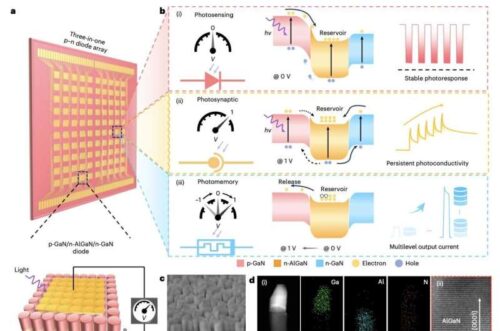
A p–n diode can perform sensing, memory, and processing in a single device, reducing the need for components in electronic systems. The device, developed by researchers at the University of Science and Technology of China and McGill University, is based on nanowire structures made from gallium nitride (GaN) and aluminum gallium nitride (AlGaN).
The study shows that band structure engineering can allow a two terminal diode to go beyond its role. By designing the internal material layers, the device integrates photosensing, data storage, and signal processing within the same structure, avoiding the complexity that comes with multi-terminal devices or new material systems.
To build this device, semiconductor nanowires were grown on a silicon layer. These nanowires are made of three regions, p type GaN, n type AlGaN, and n type GaN. P type materials carry holes, while n type materials carry electrons. The AlGaN layer has a larger bandgap than the surrounding GaN layers, meaning it requires more energy for electrons to pass through.
Placed between the other two regions, this AlGaN segment acts as a barrier that traps electrons, forming an electron reservoir. This charge trapping at the junction enables photosensing and supports behavior linked to memory and signal processing.
The structure uses p GaN n AlGaN n GaN nanowires on a silicon substrate. This configuration allows the diode to manage multiple functions within the same device.
Tests show that the diode can handle sensing, data processing, and data storage together. It has been used to build an image sensor capable of both collecting and analyzing visual data.
Approaches to add more functions such as using devices with more terminals or introducing new materials often increase hardware and processing complexity. This work shows that modifying the band structure within a diode design can overcome these limits.
The device can also be arranged in arrays to create image sensors with built in functions such as noise reduction and image classification, without relying on extra circuits.
This design opens a path toward nanowire based devices that combine sensing, memory, and processing, supporting the development of electronic systems for specific applications.