




What if medical device manufacturers could achieve reliable adhesive curing even in areas where UV light cannot fully reach reliability?
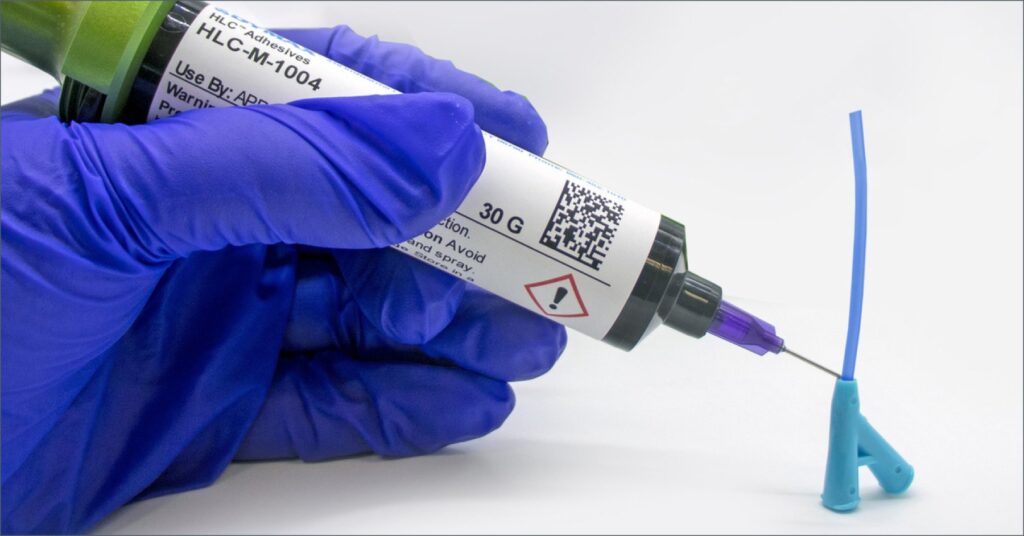
Dymax has introduced HLC M 1004, a low viscosity medical adhesive designed for assembling complex medical devices that include opaque or light blocking components.
The adhesive expands the company’s HLC adhesive portfolio, which uses a hybrid light curable platform capable of curing in both light exposed and shadowed areas. The material combines rapid UV or visible light curing with on contact curing in dark regions, helping manufacturers achieve consistent bonding across complex device geometries where conventional light cure adhesives may struggle.
Designed for medical assembly applications such as catheters, diagnostic systems, therapeutic devices, and components incorporating opaque substrates, the adhesive is formulated for controlled dispensing and penetration into narrow bond gaps. Its low viscosity characteristics support uniform adhesive flow while eliminating the need for primers during assembly.
The company states that the adhesive provides rapid fixturing to support high throughput manufacturing processes while maintaining flexibility after curing. Additional features include reduced blooming under proper curing conditions and improved cosmetic appearance of bonded assemblies.
The material has also been evaluated according to applicable ISO 10993 biocompatibility standards, making it suitable for medical device manufacturing environments. As a one part adhesive containing no nonreactive solvents, the formulation is intended to simplify handling, reduce material waste, and streamline production workflows.
By combining shadow area curing capability with low viscosity dispensing characteristics, the adhesive is designed to address growing manufacturing challenges associated with increasingly compact and geometrically complex medical devices. The release further expands hybrid light curing adhesive options for manufacturers requiring reliable bonding performance in both exposed and difficult to reach assembly regions.
Click here for the official announcement.


