




A robotic hand that switches between multiple grippers using a single motor, reducing complexity while showing promise in object-handling capabilities for industrial, service and assistive robotics.
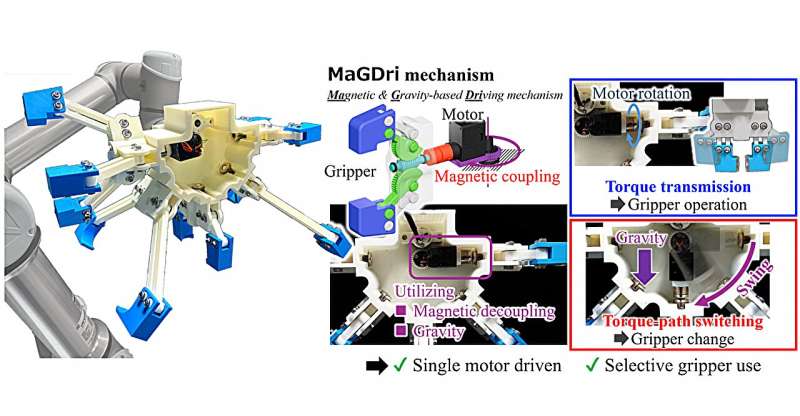
Robotic hands capable of handling objects with different shapes and materials typically require multiple motors or complex tool-changing mechanisms, increasing weight, cost and control complexity. Researchers at Kanazawa University have now developed a robotic hand that overcomes these limitations by operating multiple grippers with a single motor through an innovative gravity-assisted mechanical design.
The prototype introduces the MaGDri (magnetic and gravity-based driving) mechanism, which uses gravity to switch the motor’s torque path between different gripping units. Rather than relying on additional actuators or sophisticated electronic control, the system mechanically selects the appropriate gripper based on its orientation, allowing one motor to drive several end-effectors. This simplifies the robotic hand while maintaining the flexibility to grasp objects with varying shapes, sizes and rigidity.
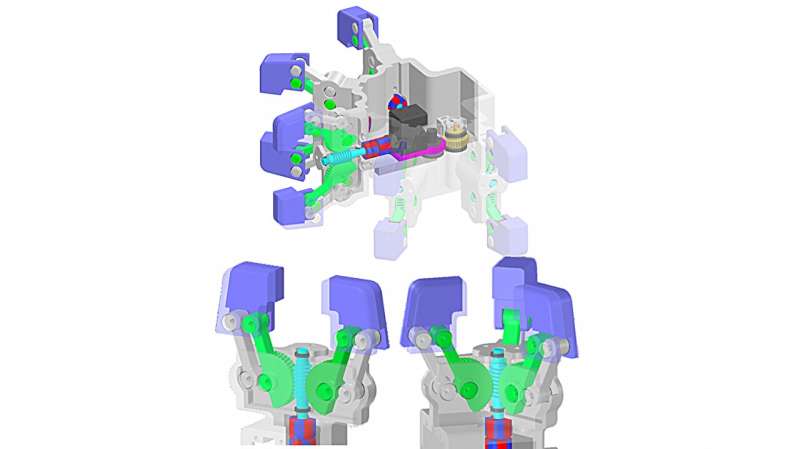
Researchers validated the concept using prototype robotic hands equipped with multiple gripping units. Experimental results showed that the mechanism could reliably switch between grippers and select the most suitable grasping method without requiring extra motors or complex control algorithms. By shifting functionality from electronics to mechanical design, the approach demonstrates a new way to build multifunctional robotic manipulators that are lighter and more energy efficient.
Because a single actuator powers multiple gripping mechanisms, the design significantly reduces component count, weight, installation space and manufacturing cost. The simplified architecture could also improve reliability by minimizing moving parts and reducing maintenance requirements. The researchers describe the gravity-driven torque-path switching mechanism as a new design principle for robotic hands that can expand functionality without increasing actuator count.
The technology could find applications across industrial automation, warehouse logistics, retail handling, domestic service robots, healthcare assistance and disaster-response systems, where robots must manipulate diverse objects safely and efficiently. A single robotic hand capable of adapting its gripping method without changing tools would enable more versatile automation while lowering hardware complexity.
The research, published in IEEE Robotics and Automation Letters, highlights how intelligent mechanical engineering can complement advances in robotics and embedded control. As demand grows for compact, affordable and multifunctional robotic platforms, gravity-assisted actuation mechanisms such as MaGDri may help designers develop next-generation robotic hands with greater versatility and lower power consumption.


