





An AI system trained on just a few steps of stick insect movement helped a six-legged robot learn to walk in an hour and adapt to uneven terrain and a missing limb.
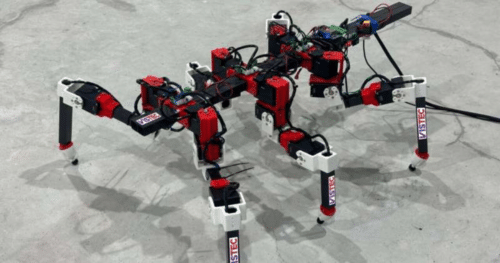
Researchers led by Tohoku University and the Vidyasirimedhi Institute of Science and Technology have developed an AI-based approach that enables a six-legged robot to learn locomotion from the walking behaviour of a stick insect. Using an open dataset containing only three or four steps of insect movement, the system inferred the underlying locomotion objective and developed a control strategy for the robot. The resulting machine learned to walk in about one hour and could adapt to uneven terrain and a missing limb.
The researchers used adversarial inverse reinforcement learning, in which the AI is not explicitly programmed with instructions for how each leg should move. Instead, it analyses examples of desired behaviour to infer the underlying objective, represented as a reward, and then develops a control strategy to achieve it. This differs from conventional approaches that require engineers to manually define individual leg movements or gait patterns.
In testing, the robot learned to walk three times faster than with a standard reward design. The approach also separates learned information into two categories: one representing locomotion principles that can be applied generally and another specific to the individual robot. This allows the learned results to be transferred to robots with different body structures, reducing the need to train each machine from the beginning.
The researchers demonstrated the method on the RedMirror six-legged robot. They found that a few steps from a single stick insect were enough to identify a locomotion principle that could be transferred to a machine about five times the insect’s size. The study suggests that other animals with complex and dexterous movement could also provide useful biological models for robot-learning systems.
“We never told the robot how to walk,” explains Dai Owaki, associate professor at Tohoku University. “We asked what the insect was trying to achieve, and let the robot chase the same thing entirely on its own.”
The researchers plan to add memory, allowing robots to accumulate and use experience over time. Such an approach could eventually support highly mobile robots designed for environments where wheeled machines have difficulty operating, including disaster-response scenarios.
For India, the approach is relevant to research into legged and bio-inspired robots for difficult terrain. A learning method that requires only a small number of example movements, rather than extensive motion-capture datasets or manually tuned gait controllers, could potentially reduce the data and engineering effort required to experiment with new locomotion strategies. The disaster-response applications highlighted by the researchers are also relevant to environments such as earthquake-affected mountainous regions and flood-hit areas, where uneven or unstable surfaces can limit wheeled robots. However, the RedMirror remains a research platform, and translating the laboratory demonstration into a field-deployable robot would require considerably more testing across real-world terrain and operating conditions.
For more information, click here.

