What if one board could handle a screen, sensors, Bluetooth, and battery support for your next smart device?
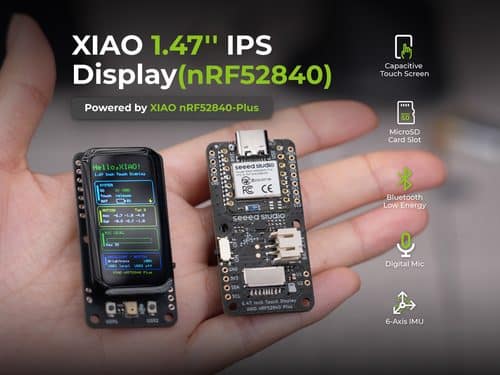
Seeed Studio has launched the XIAO IPS Display series, a family of compact boards that combine a colour IPS display, 6-axis inertial measurement unit (IMU), PDM digital microphone, Bluetooth Low Energy (BLE), and LiPo battery management on a single board.
Based on the Seeed Studio XIAO nRF52840 Plus, the boards are designed for small connected devices such as smart badges, wearables, portable human-machine interfaces (HMIs), sensor displays, and BLE gadgets. They are compatible with the Arduino Integrated Development Environment (IDE).
The 1.47-inch version is aimed at projects that need an interactive display. It has a 172 × 320-pixel IPS TFT LCD with capacitive touch and a MicroSD card slot. These features allow developers to build graphical user interfaces (GUIs), dashboards, local media playback, and on-device data logging.
The 1.14-inch version uses a 135 × 240-pixel IPS TFT LCD without touch. It adds a Grove I2C connector and three user buttons, making it suitable for projects that need external sensors or physical controls.
The 0.96-inch version focuses on a smaller footprint. Measuring 17.8 × 42 mm, it is designed for applications such as smart badges, small wearables, and BLE status displays.
The boards support a 3.7 V lithium-polymer (LiPo) battery through a 2-pin JST 2.0 connector. Battery-status detection and battery-voltage monitoring are also supported.
The 1.47-inch model measures 25 × 50 mm and uses the JD9853A display driver. It provides I2C, I2S, and serial wire debug (SWD) pads, along with two user-button pads.
The 0.96-inch model measures 17.8 × 42 mm and uses the ST7789 display driver. It provides I2C and I2S pads and leaves out the larger connectors found on the other models to keep the board compact.
The XIAO nRF52840 Plus provides nine additional GPIOs compared with the standard XIAO nRF52840 through redesigned castellated pads and rear pads for surface-mount device (SMD) soldering. The additional I/O allows the different peripherals on the boards to be integrated without requiring a separate controller board.
Click here for the original announcement.