




Can protective clothing be worn without using your hands? Soft robotics is making rapid, self-assisted dressing a practical reality.
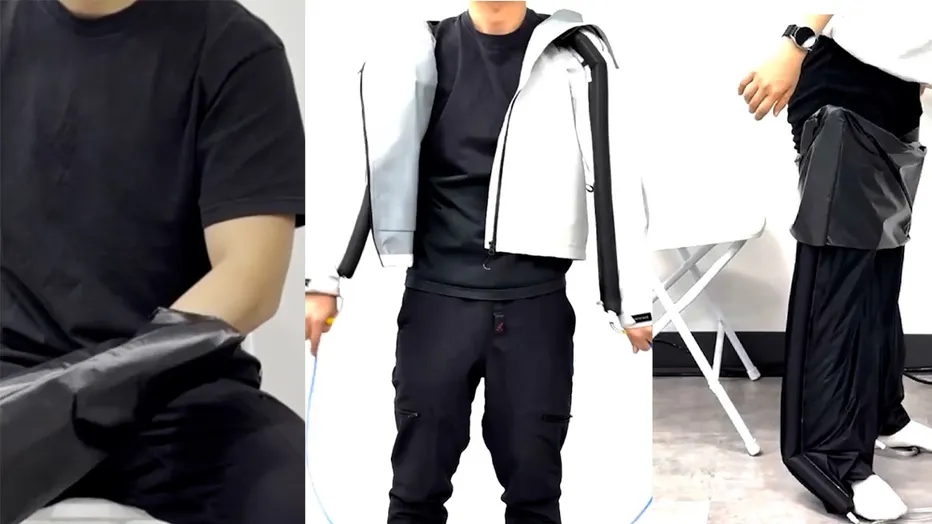
Researchers from Stanford University and the Korea Advanced Institute of Science and Technology (KAIST) have developed a soft robotic garment that enables users to wear protective clothing without using their hands, and uses inflatable robotic structures embedded within fabric to automatically guide garments over the wearer’s body in around 10 seconds.
The development addresses challenges faced by people with limited mobility while also offering potential benefits for industries where protective clothing must be worn quickly and correctly. Researchers believe the technology could reduce the time required for workers to enter semiconductor cleanrooms, help emergency responders rapidly don personal protective equipment (PPE), and simplify daily dressing for elderly or disabled users.
The system integrates flexible, air-powered “vine” robots directly into clothing. Inspired by the growth of climbing plants, the robotic structures inflate and extend from their tips, turning the garment inside out as they move over the body. Unlike conventional robotic systems that rely on precise positioning and complex control algorithms, the inflatable vines adapt to the wearer’s shape and movement while navigating curved surfaces and narrow spaces. The researchers said the design also allows the system to operate across surfaces with varying friction, including slippery, sticky, and inclined conditions, making it suitable for dynamic real-world environments.
The team believes the work demonstrates how advances in soft robotics and mechanical design can improve human-machine interaction without relying solely on artificial intelligence. Future applications could extend beyond assistive technologies to industrial safety equipment and specialised protective wear used in hazardous environments.
“The vine robot stays close to the person and dresses them by turning the clothing inside out as it moves, allowing it to climb stably along the shape of the body,” says Kim Nam Gyun, Postdoctoral Researcher at KAIST and lead author of the study.


