Can robots react to touch without electronics? A soft sensor converts force directly into action using a fully mechanical design.
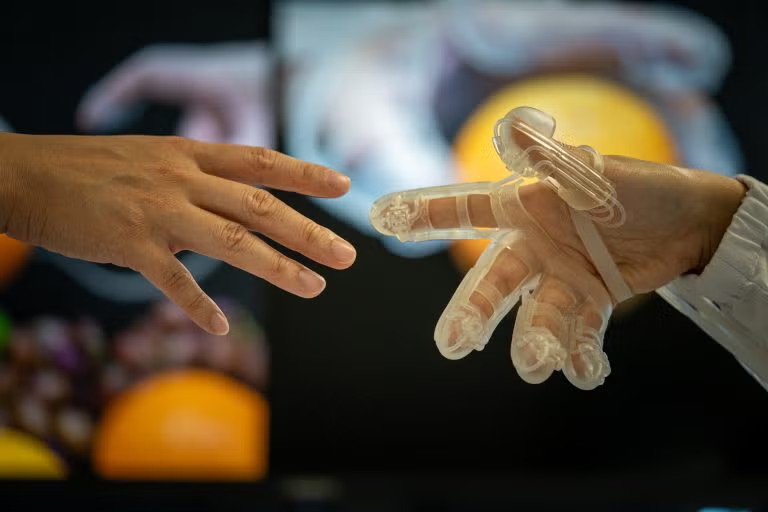
Researchers at the National University of Singapore’s College of Design and Engineering (NUS CDE) have developed a soft mechanical force sensor that enables robots to sense and respond to touch without electronics, external power or computational processing. Named ME-SOFS (mechanical soft force sensor), the device converts applied force directly into fluidic actuation, creating a complete sensing-to-action loop through purely mechanical means.
The research addresses a key challenge in soft robotics, where sensing, signal processing and actuation typically depend on multiple electronic components. By removing these elements, the design could reduce system complexity while enabling robots to operate reliably in environments where electronics are prone to failure, including underwater, high-temperature and high-pressure conditions.
The 3D-printed sensor features a central pillar surrounded by five fluid-filled chambers. When force is applied, the pillar compresses the corresponding chamber, generating fluid flow that directly drives an actuator. The design independently detects forces along three axes, while its sensitivity can be tuned by modifying the sensor’s geometry. The displaced fluid also generates measurable voltage pulses through electromagnetic induction, providing force readouts without powered electronics.
The team demonstrated the technology in a robotic glove capable of estimating object weight, a haptic feedback system that allowed operators to feel a robotic gripper’s force, a miniature fluid controller and flexible hair-like structures that responded to touch. The sensor also maintained stable performance in water at 90°C and under pressures equivalent to around 11 metres depth.

Dr Yang Kelu, Research Fellow from the Department of Materials Science and Engineering, says, “By turning force directly into action, without relying on electronics or a processing unit, ME-SOFS has a range of potential applications. In medical training, this could allow trainees to feel the same force feedback as an expert performing a complex movement. This direct sensing-to-action response is what makes the system especially promising for soft robots that need to interact safely with people.”