




A compact thermal polarisation modulator using phase-change material, offers a non-mechanical approach to increase optical data capacity for future communication networks and photonic computing.
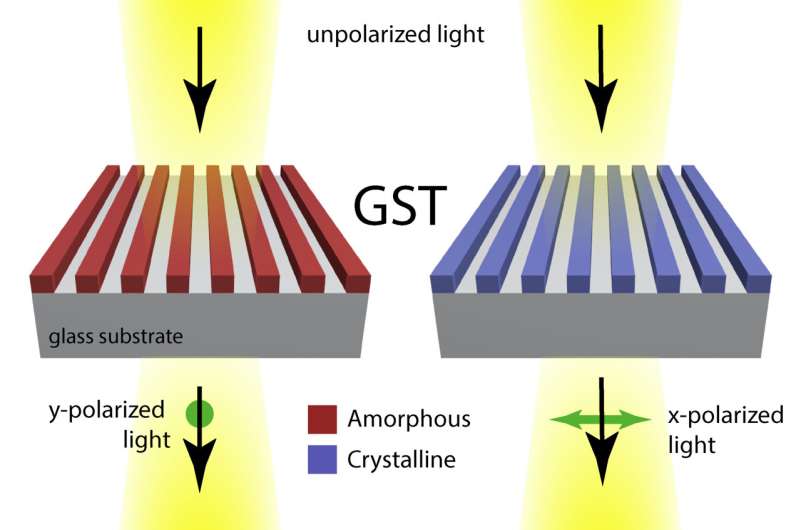
A research team at the Skolkovo Institute of Science and Technology, led by Nicolas Posunko, has developed a prototype optical modulator that controls light polarisation through heat rather than mechanical motion, potentially enabling faster, denser, and more compact optical communication systems. The device exploits a phase-change material to switch polarisation states, allowing additional information to be encoded onto a single light beam without moving optical components.
Polarisation is one of light’s fundamental properties and can serve as an extra information channel alongside conventional modulation techniques. Existing polarisation control devices in optical circuits often rely on mechanically rotating components, limiting switching speed, increasing system complexity and reducing long-term reliability. The newly demonstrated approach replaces moving parts with thermally induced phase transitions in a nanoscale material.
The prototype, developed by researchers from Skoltech and collaborating institutions, uses germanium-antimony-tellurium (GST), a well-known phase-change material widely used in rewritable optical storage media. GST can reversibly switch between crystalline and amorphous states, with each state exhibiting distinct optical properties. By incorporating GST into a microscopic diffraction grating, the researchers created a device that changes the polarisation of transmitted light simply by heating the material.
Measuring less than one-hundredth of a square centimetre, the modulator demonstrates that polarisation switching can be achieved without rotating optics. In the proof-of-concept prototype, the team intentionally employed relatively slow switching techniques—furnace annealing and laser scanning—to maximise optical contrast and validate the concept rather than optimise operating speed. Future versions are expected to adopt faster electrical heating methods suitable for practical photonic systems.
The technology could become an important building block for next-generation optical transceivers, where electrical signals are converted into optical ones for fibre-optic communication. By using polarisation as an additional data channel, communication systems could significantly increase information throughput without requiring extra optical fibres or wavelengths. Such capability is increasingly relevant for AI data centres, high-performance computing clusters and future optical computing architectures that demand ever-higher bandwidth.
Beyond telecommunications, the compact, non-mechanical design could benefit integrated photonic circuits, optical signal processing and emerging photonic computing platforms, where eliminating moving components improves speed, reliability and scalability. If future refinements achieve high-speed electrical switching while maintaining strong polarisation contrast, the approach may provide a practical alternative to conventional mechanical polarisation modulators in advanced optical networks.


