





A network of tiny magnetic devices can work together to help future computers run faster while using less power for AI and data processing.
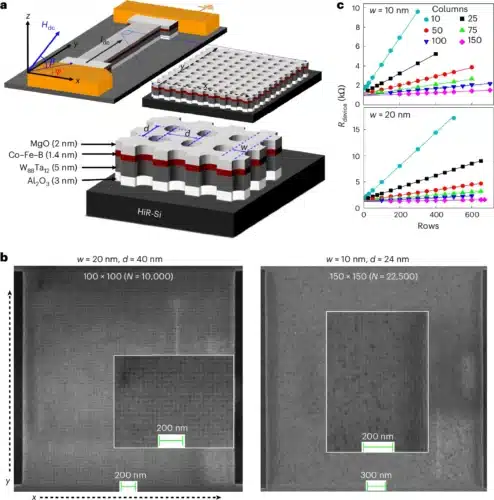
An international team of researchers, including scientists from IIT Bhubaneswar, has developed the world’s largest synchronized network of more than 100,000 nanoscale spintronic oscillators. The breakthrough, published in Nature Nanotechnology, could help develop future computers that process complex tasks faster while using much less energy.
Spintronic oscillators are tiny magnetic devices that can work together by synchronizing their operation. In the study, the researchers showed that the devices synchronized in just 45 nanoseconds, allowing them to process information quickly and efficiently.
The synchronized network is around 1,000 times larger than previously demonstrated coherent spintronic systems. According to the researchers, this shows that the technology can be scaled for practical computing applications.
The team used microwave and optical microscopy techniques to observe how thousands of the devices spontaneously synchronized into a single network. The results show that very large spintronic networks can coordinate rapidly, an important step toward developing new computing hardware.
Although the technology is still in the research phase, it could support future applications such as energy-efficient AI systems, communication networks, real-time data processing, financial modelling, intelligent transport systems, and large-scale scientific simulations.
Dr. Nilamani Behera, Assistant Professor in the Department of Physics at IIT Bhubaneswar and one of the lead authors of the study, said: “The demand for computing power is growing rapidly, especially with the rise of artificial intelligence. Our work demonstrates that very large networks of nanoscale magnetic devices can naturally synchronize in just a few billionths of a second. This opens exciting possibilities for developing future computing technologies that are both faster and far more energy-efficient.”
The findings improve the understanding of how large networks of interacting nanoscale devices behave and provide a foundation for developing brain-inspired computing hardware. According to the researchers, such systems could overcome the energy and performance limits of conventional computers and support the development of future intelligent computing technologies.
