




Transformers help you build PoE and DC/DC power supplies with different voltage, current, and isolation requirements.
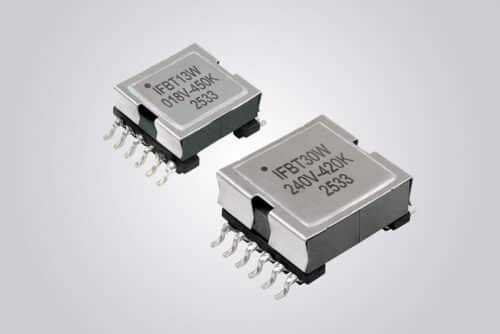
Vishay Intertechnology has introduced the Dale IFBT series, a range of 17 surface-mount flyback transformers for designers developing PoE power supplies and isolated DC/DC converters up to 30 W.
The transformers support 26 V to 72 V input voltages at 250 kHz and provide 1500 VRMS isolation for 60 seconds between the primary and bias windings and the secondary. Depending on the configuration, designers can achieve 1.8 V to 24 V output voltages and 0.5 A to 9 A output currents.
The IFBT series uses multiple windings that can be connected in series or parallel. This allows engineers to select a winding configuration based on the voltage and current requirements of the power supply. The transformers can be used to build 6 W and 30 W PoE designs, as well as isolated DC/DC converters rated up to 30 W.
For example, a power electronics engineer designing an industrial control system can use an IFBT transformer in a flyback converter to generate an isolated low-voltage supply from a higher-voltage input. The same approach can be used in telecom equipment, building controls, energy systems, and automotive LED driver circuits.
The transformers have inductance values between 35 µH and 75 µH and operate from -40°C to +125°C. Their surface-mount format allows them to be placed directly on PCBs, making them suitable for compact power supply designs.
The series also uses an open construction, which allows designers to modify the windings when a particular application requires a different configuration. This can help engineers adapt the transformer to specific voltage, current, or circuit requirements instead of designing around a fixed winding arrangement.
The RoHS-compliant transformers are intended for applications including automotive lighting, energy generation and distribution, industrial drives and automation, home and building controls, consumer electronics, white goods, telecom equipment, and medical instrumentation.
Click here for the original announcement.
