

A five-nanometre chromium barrier could replace costly gold electrodes, improving durability while keeping perovskite solar cells efficient, stable and far more affordable for large-scale deployment.
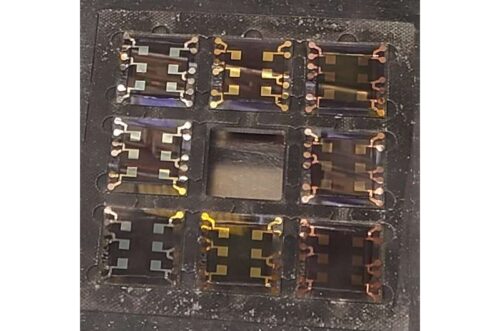
Researchers have found a cheaper route to durable perovskite solar cells, using a five-nanometre chromium barrier instead of relying on costly gold electrodes. Tino Lukas, whose earlier analytical work included Merck, and collaborators at the University of Oxford and Chinese University of Hong Kong developed the approach to make the technology more practical for large-scale deployment.
The chromium layer sits between the perovskite and a low-cost metal such as aluminium, copper or silver. Tests showed that it can block halide ions from reaching and corroding the underlying metal. Aluminium benefited particularly strongly, achieving stability comparable with gold while using raw materials costing roughly one-hundred-thousandth as much.
The researchers also identified a separate weakness in the transparent front electrode. Conventional indium tin oxide, or ITO, can release indium ions into the perovskite layer. These ions can create defects that accelerate degradation under heat and light.
Replacing ITO with fluorine-doped tin oxide, or FTO, largely removed that pathway. The team then combined FTO at the front with a chromium-aluminium bilayer at the back, producing devices that retained more than 66 per cent of their initial efficiency after over 1000 hours at 75°C under simulated sunlight.
Performance did not have to be sacrificed for durability. Devices using the low-cost electrode combination reached a power conversion efficiency of 24.7 per cent, comparable with leading gold-electrode devices reported in the field.
The researchers say the significance lies in the materials’ practicality. Chromium, aluminium and FTO are widely available and already used in industrial technologies, potentially easing scale-up.
The findings also suggest that electrode selection deserves greater attention as perovskite photovoltaics move towards commercial manufacturing. The work does not represent a finished industrial solution, but it offers a route that could reduce material costs while addressing one of the technology’s biggest durability challenges.