

Researchers have demonstrated heat-driven elastocaloric cooling, pointing towards lower-electricity refrigeration through shape-memory alloys and waste heat, while highlighting durability and manufacturing challenges for wider adoption.
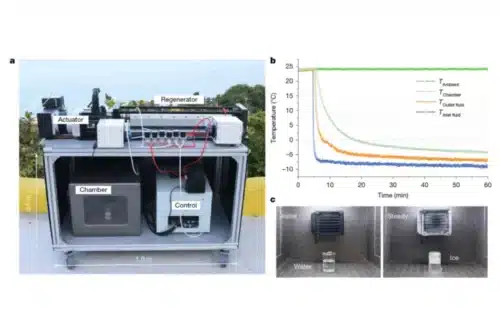
Researchers at Tohoku University and the Karlsruhe Institute of Technology have demonstrated a waste-heat-activated prototype cooling system, showing how elastocaloric technology could reduce electricity use in refrigeration. The approach uses shape-memory alloys and mechanical stress to generate cooling, offering a potential alternative to conventional electrically driven systems.
The prototype achieved a temperature span of 12.9K at the refrigerant level and 4.0K at the device level when activated using Joule-heated actuation at 86°C. When driven by an external heat source, the system maintained a device-level temperature span of 2.2K, demonstrating the feasibility of heat-driven elastocaloric cooling.
Elastocaloric cooling relies on mechanical stress rather than conventional refrigerant-based processes. Materials such as nickel-titanium generate heat when stretched or compressed and cool rapidly when the applied stress is released.
The latest demonstration builds on earlier research into elastocaloric systems. Researchers at the Hong Kong University of Science and Technology previously developed a kilowatt-scale device that could stabilise indoor temperatures at around 21–22°C within 15 minutes when outdoor temperatures reached 30–31°C.
The technology could eventually support more energy-efficient cooling by using available waste heat instead of relying entirely on electricity. This could be particularly relevant for industrial facilities and other settings where low-grade heat is readily available.
However, significant challenges remain before commercial deployment. Researchers identify system durability and manufacturing costs as key barriers. Improving the long-term reliability of the materials and developing cost-effective manufacturing methods will therefore be important for scaling the technology.
If these challenges can be addressed, elastocaloric cooling could provide a promising route towards lower-electricity refrigeration and temperature-control systems.