Wearable glasses convert infrared light into visible colours, allowing users to see infrared and visible light at the same time.
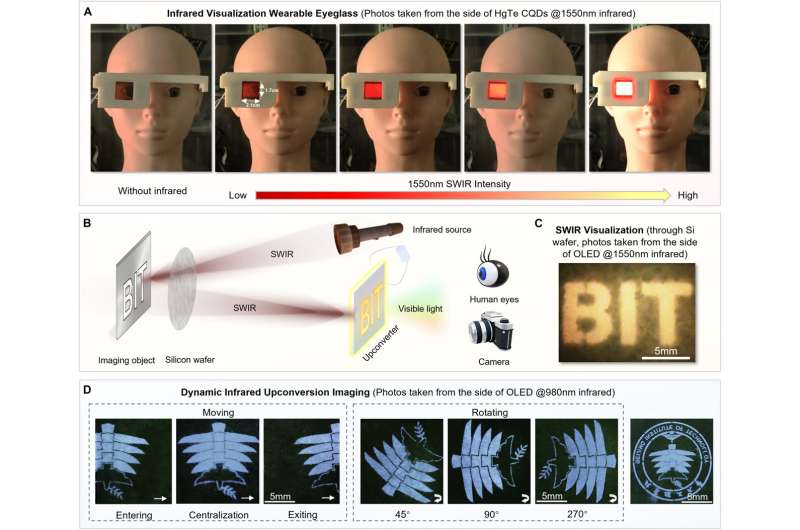
Scientists at the Beijing Institute of Technology have developed wearable glasses that convert invisible infrared light into full-colour visible images. The device allows users to see infrared and visible light at the same time by translating infrared signals into different colours based on their wavelength and intensity.
The prototype weighs 23 grams (0.8 ounces) and was tested by projecting infrared light through different shapes and moving objects. The tests showed that the glasses produced colour-coded infrared images while allowing visible light to pass through. This enables users to view both the visible scene and the infrared image at the same time.
The researchers also measured electrical responses in human eyes and found that the converted light triggered retinal responses, showing that the eye can process the converted infrared information.
Unlike conventional night-vision goggles and thermal cameras, which usually display infrared images in a single colour such as green or in black and white, the technology converts infrared light into multiple visible colours. The colours represent differences in the wavelength and intensity of infrared light, making it easier for users to distinguish variations because the human eye is better at identifying colours than differences in brightness.

Human eyes cannot detect infrared light because infrared photons do not carry enough energy to activate the retina. Existing infrared imaging systems overcome this limitation but generally provide monochrome images.
The device uses mercury telluride colloidal quantum dots to absorb infrared light and convert it into electrical charges. These charges are transferred to an organic light-emitting diode (OLED) that contains red and cyan colour zones.
Lower-energy infrared signals generate enough charge to illuminate only the red region of the OLED, while higher-energy signals activate both the red and cyan regions. This produces different visible colours corresponding to different infrared wavelengths and intensities.
Although the technology is still at the prototype stage, the researchers believe it could support applications beyond infrared vision. According to the team, the approach could contribute to future visual prosthetics and other technologies designed to expand the range of light that humans can perceive.