


MIT researchers uncover a hidden 3D atomic structure in relaxor ferroelectrics using electron ptychography, resolving a decades-old mystery and enabling improved design of advanced electronic, sensing, and energy materials.
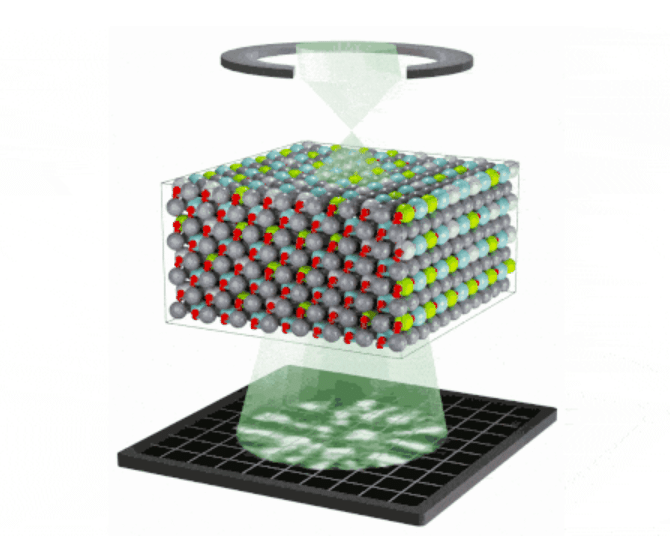
A long-standing mystery in materials science has been resolved after researchers at the Massachusetts Institute of Technology (MIT) directly mapped the hidden three-dimensional atomic structure of a widely used class of electronic materials known as relaxor ferroelectrics.

The study reveals how nanoscale chemical disorder and polar structures inside these materials govern their exceptional properties, which are already used in ultrasound imaging, sensors, actuators, and sonar systems. Until now, scientists could not directly observe how atomic-level charge distributions were arranged in three dimensions, limiting the accuracy of predictive models used for material design.
To overcome this, the MIT-led team applied a cutting-edge imaging technique called multi-slice electron ptychography (MEP). The method scans a focused electron beam across the material and records overlapping diffraction patterns. Advanced reconstruction algorithms then convert this data into a full 3D map of atomic and electronic structure.
The resulting images revealed a far more complex internal landscape than previously assumed. Researchers found a hierarchy of nanoscale regions with varying polarisation, many of them significantly smaller and more irregular than predicted by leading computational models. This directly challenges long-held assumptions about how these materials behave under electric fields.

By feeding the experimental data back into simulations, the team refined existing theoretical models, improving their ability to predict material behaviour under different operating conditions. The work establishes a tighter feedback loop between experiment and computation, an increasingly critical approach in modern materials science.
According to the researchers, the breakthrough not only resolves a decades-old gap in understanding but also provides a powerful framework for engineering next-generation materials. Better control of relaxor ferroelectrics could lead to more efficient energy storage systems, higher-performance sensors, and improved electronic components.
The study also demonstrates the growing importance of advanced electron microscopy techniques in probing disordered and complex materials, where traditional crystallographic methods fall short. Researchers say the same approach could be extended to other technologically important materials systems where atomic disorder plays a key role in performance.
The findings mark a step forward in the broader effort to design materials by understanding—and ultimately controlling—their atomic-scale structure rather than relying on trial-and-error development.