




What if a charger delivers power perfectly but still has a safety response that needs testing? The answer lies in what happens when engineers introduce a fault.
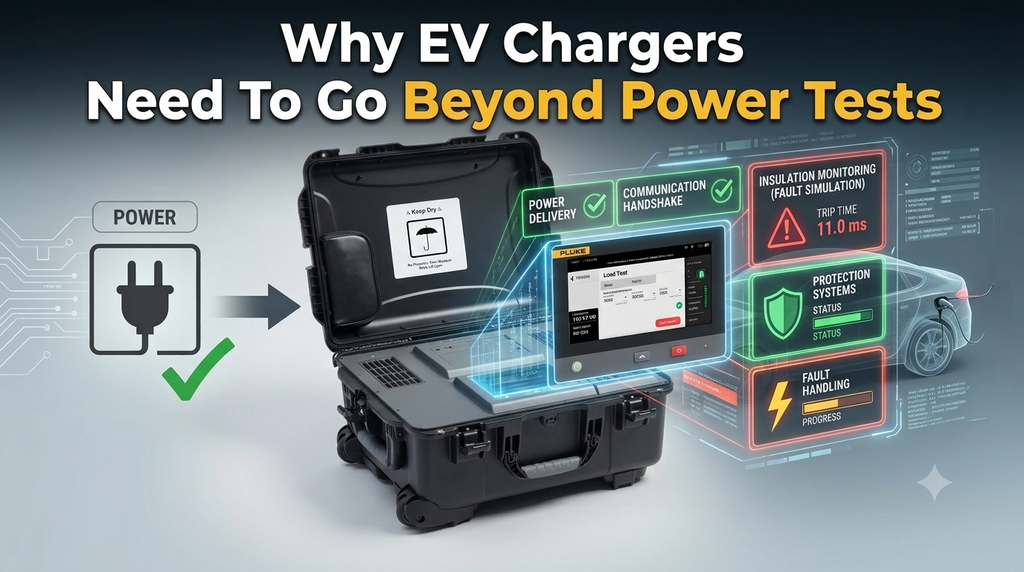
A charger successfully powering an electric vehicle (EV) does not tell the whole story. While power delivery confirms that charging is possible, it does not necessarily show whether the charger’s communication, protection, and fault-handling systems work as intended. As high-power DC chargers become increasingly common, testing how a charger responds beyond normal power delivery becomes important for verifying its overall safety and reliability.
In an exclusive interaction with EFY, Dr Utsav Sharma, product manager, Fluke Technologies, explained why communication, safety responses, and fault handling also need to be validated. The FEV500 approaches this by simulating an electric vehicle and reproducing different stages of the charging interaction. It establishes communication with the charger, checks handshake signals, verifies safety protocols, and evaluates power delivery. It can also deliberately introduce fault conditions to determine whether the charger’s protective systems respond as expected.
One such test deliberately creates a low-resistance condition between DC negative and protective earth. The tester then checks whether the insulation monitoring device trips within the expected time. If the protection mechanism does not respond, the test fails, even if the charger can otherwise deliver power.

This makes charger testing less about asking, “Can it charge?” and more about, “How does it behave when something goes wrong?” For technicians, that distinction can help identify whether a failure lies in communication, power delivery, or a safety function, allowing the appropriate technical intervention to follow.

Sharma also argues that testing should not stop at power delivery. “We need to test a charger without any EV and we have to test all the parameters, not only the power delivery,” he said.
But what actually happens when a tester takes the place of an EV? How does it reproduce the charging handshake, and what can a deliberately injected fault reveal that a normal charging session cannot? The full interaction with Dr Utsav Sharma explores these questions, along with interoperability, preventive testing, and the engineering challenges behind keeping charging infrastructure dependable.

