




HomeElectronics NewsWindow-sized Device Pulls Drinking Water from Air

Window-sized Device Pulls Drinking Water from Air

The device pulls water from air, even in dry places. Gel inside collects water without needing rivers, lakes, or other sources.
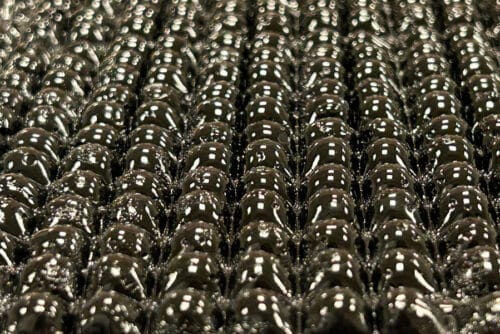
Caption:A close-up of a new origami-inspired hydrogel material, designed by MIT engineers, that swells to absorb water from the air. When water condenses out of the material to be collected, the individual hydrogel spheres shrink back down to capture more moisture.
Credits:Credit: Courtesy of the researchers
Caption:A close-up of a new origami-inspired hydrogel material, designed by MIT engineers, that swells to absorb water from the air. When water condenses out of the material to be collected, the individual hydrogel spheres shrink back down to capture more moisture. Credit: Courtesy of the researchers

As demand for drinking water increases, sources like rivers, lakes, and reservoirs face pressure. In response, MIT engineers have developed a system that collects water from the air, which contains water vapor.

- Advertisement -

The system is an atmospheric water harvester that captures vapor and turns it into drinking water, even in areas like deserts.

The device is a black, vertical panel, about the size of a window. Inside, it holds a water-absorbing hydrogel, placed within a glass chamber with a cooling layer on top. The hydrogel is like bubble wrap with dome-shaped structures that expand as they absorb vapor.

When the vapor evaporates, the domes shrink, like folding paper. The vapor condenses on the glass surface, flows through a tube, and collects as drinking water.

- Advertisement -

Hydrogels are sponge-like materials made of water and a network of polymer fibers. Zhao’s team at MIT studied these hydrogels for medical uses, such as implant coatings, electrodes, and imaging patches.

Other materials like metal-organic frameworks (MOFs) have also been used to capture vapor. MOFs are porous but do not expand when absorbing water, which limits storage capacity.

In this design, glycerol was added to stabilize the salt, preventing leaks and crystal formation. The structure of the hydrogel was adjusted to avoid tiny pores, which helps keep the salt inside.

The team reshaped the hydrogel into dome-like structures instead of sheets. This shape increases surface area, allowing the hydrogel to absorb more vapor.

They built a half-square-meter sheet of this hydrogel and placed it inside a glass chamber. The glass surface was coated with a cooling film that helps vapor condense. A tube system collects the condensed water.

This design allows water to be collected in desert-like conditions where water sources do not exist.

The use of glycerol and improved hydrogel structure keeps salt from leaking, so the collected water is safe for drinking, with salt levels below limits.

With its design and performance, this system offers a way to provide drinking water in areas facing shortages, without access to rivers, lakes, or groundwater.


Nidhi Agarwal
Nidhi Agarwal
Nidhi Agarwal is a Senior Technology Journalist at Electronics For You, specialising in embedded systems, development boards, and IoT cloud solutions. With a Master’s degree in Signal Processing, she combines strong technical knowledge with hands-on industry experience to deliver clear, insightful, and application-focused content. Nidhi began her career in engineering roles, working as a Product Engineer at Makerdemy, where she gained practical exposure to IoT systems, development platforms, and real-world implementation challenges. She has also worked as an IoT intern and robotics developer, building a solid foundation in hardware-software integration and emerging technologies. Before transitioning fully into technology journalism, she spent several years in academia as an Assistant Professor and Lecturer, teaching electronics and related subjects. This background reflects in her writing, which is structured, easy to understand, and highly educational for both students and professionals. At Electronics For You, Nidhi covers a wide range of topics including embedded development, cloud-connected devices, and next-generation electronics platforms. Her work focuses on simplifying complex technologies while maintaining technical accuracy, helping engineers, developers, and learners stay updated in a rapidly evolving ecosystem.

SHARE YOUR THOUGHTS & COMMENTS

EFY Prime

Unique DIY Projects

Electronics News

Truly Innovative Electronics

Latest DIY Videos

Electronics Components

Electronics Jobs

Calculators For Electronics
