




Princeton researchers have developed a machine-learning system that curves ultrahigh-frequency signals around obstacles, solving one of the biggest barriers to sub-terahertz wireless, this paves the way for data speeds up to 10x faster—fueling next-gen virtual reality, autonomous vehicles, and beyond.
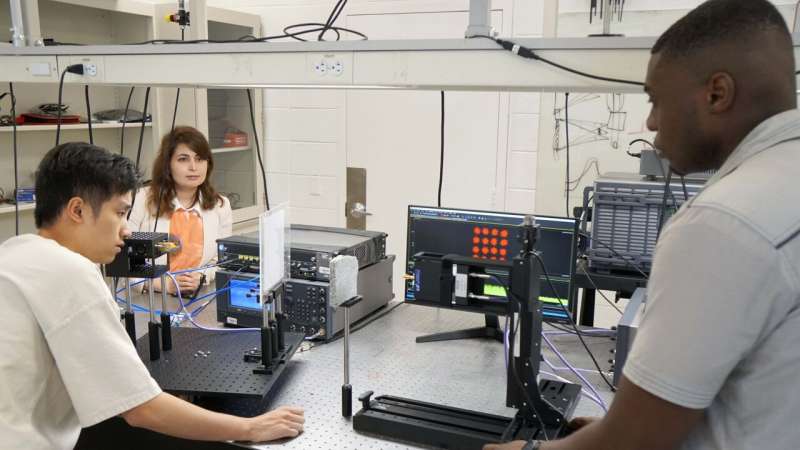
Engineers at Princeton University have demonstrated a breakthrough system that allows ultrahigh-frequency transmissions to bend around obstacles, potentially transforming wireless communication at sub-terahertz frequencies. Reported in Nature Communications, the technology could deliver data at speeds up to 10 times faster than today’s systems—critical for virtual reality, autonomous vehicles, and immersive applications.
The challenge with sub-terahertz signals is that, unlike lower-frequency radio waves, they travel in tight beams that are easily blocked by walls, furniture, or even people in motion. Current workarounds rely on reflectors, which are often impractical in dynamic settings. The team, led by electrical engineering professor Yasaman Ghasempour, tackled this limitation by reviving a physics concept first proposed in 1979—Airy beams, special radio waves that can curve like a thrown curveball.
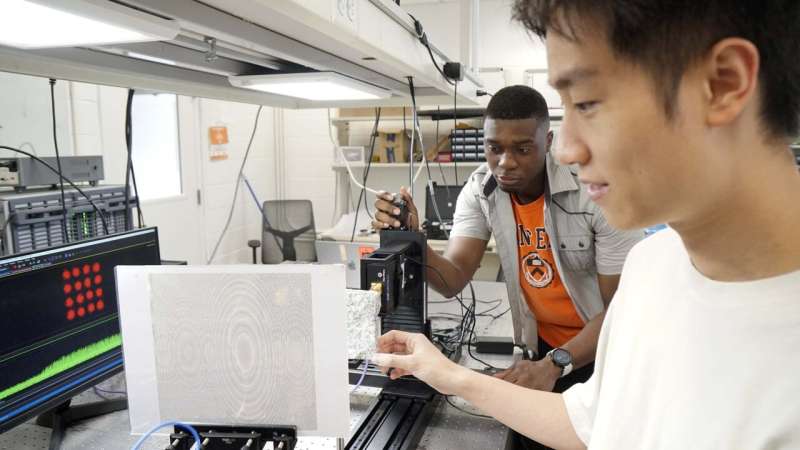
The system is powered by a neural network that acts much like an athlete learning through practice. Instead of laboriously testing every possible beam curve, the AI learns optimal transmission patterns from a simulator built by co-author Atsutse Kludze. Once trained, the neural net rapidly selects the best curve to maintain connectivity as environments shift. To direct the signals, the researchers used a custom-designed metasurface—an engineered material capable of finely tuning wave behavior. Unlike static approaches, this adaptive system continuously recalibrates transmissions to steer around new obstacles, maintaining robust links in crowded, changing spaces.By turning once-blocked frequencies into bendable highways of data, the research points to a future where wireless networks can deliver massive bandwidth without being stopped by physical walls.
“This work tackles a long-standing barrier to adopting high-frequency wireless in everyday communication,” Ghasempour said. “With further advances, we see transmitters that can intelligently navigate even the most complex environments, bringing ultra-fast, reliable connectivity to applications from immersive VR to autonomous transportation.” By shaping signals into Airy beams and dynamically adjusting their curvature, the system effectively “dodges” obstacles in real time. Graduate researcher Haoze Chen, the paper’s lead author, said the goal was to enable reliable communication in complex indoor environments where line-of-sight connections fail.


