How can thousands of IoT devices stay connected without complex setup or high power use? A decentralised approach is targeting that challenge.
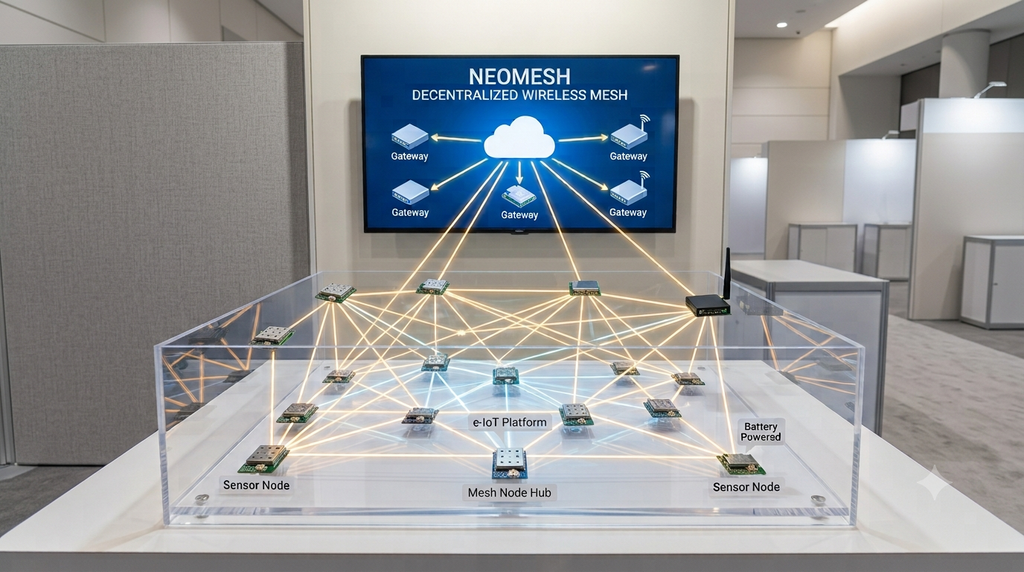
NeoCortec is demonstrating a decentralised wireless mesh networking technology designed to connect low-power IoT devices while supporting large-scale deployments and cloud connectivity for IoT applications at The Things Conference 2026.
The technology enables connected devices to communicate bidirectionally with one another and with cloud services through gateway devices. By distributing communication across multiple nodes, it can reduce reliance on individual point-to-point links and provide an alternative architecture for industrial and building IoT deployments.
A key advantage is its ultra-low-power operation, which can benefit battery-powered sensors and other devices expected to operate for extended periods with limited maintenance. Scalability is another focus, with the network designed to support a large number of connected devices without requiring each node to maintain a direct connection to a central system.
The network is fully decentralised and time-synchronised, allowing communication paths to form automatically as devices join the network. This can simplify deployment by reducing the need for manual configuration when additional sensor nodes are introduced.
The latest implementation also supports LoRa modulation, bringing the mesh architecture together with a wireless technology commonly associated with long-range, low-power connectivity. The networking technology can be implemented through dedicated communication modules or licensed for integration with different chipsets, allowing manufacturers to incorporate it into different device designs.
The company is also demonstrating integration with Endrich Bauelements’ e-IoT platform, which combines IoT nodes, smart sensors, gateway devices, and cloud services for industrial digitalisation. A live demonstration shows how sensor nodes can join without on-site configuration, form a network automatically, and transmit sensor data through a cellular gateway to the cloud.