Can quantum computing work at room temperature? A photonic architecture aims to make practical deployment in commercial data centres possible.
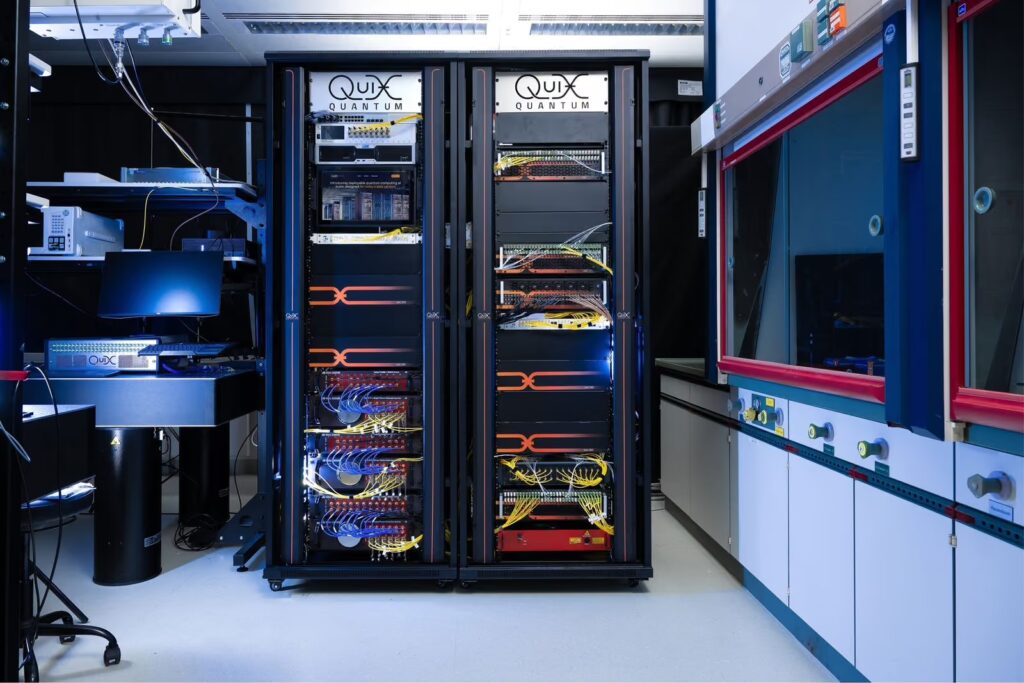
QuiX Quantum has introduced Carina, a universal photonic quantum computing architecture designed for deployment in customer data centre environments. Developed under the German Aerospace Center’s Quantum Computing Initiative (DLR QCI), the platform is intended to provide a foundation for future fault-tolerant quantum computing while integrating with existing High-Performance Computing (HPC) and AI infrastructure.
Unlike earlier photonic quantum systems that were limited to specialised computational models such as boson sampling, the architecture is built to support a universal gate set capable of executing any gate-based quantum algorithm. It combines photon generation, multiplexing, cluster-state generation, measurement, photonic assembly control and fast feed-forward control into a single stack, using single photons as physical qubits. Operating largely at room temperature, the system is designed to simplify deployment by avoiding the extensive cryogenic infrastructure required by many quantum computing platforms.
The architecture is intended to help organisations prepare operational workflows and infrastructure before utility-scale photonic quantum computers become commercially available. Compatibility with rack-based data centre systems, optical networking technologies and conventional computing environments is expected to ease integration with existing facilities while supporting future scalability.
The announcement builds on several technologies previously introduced by the company, including its Feed Forward Control Unit for converting detector signals into control actions, the Photonic Assembly Control Unit for managing photonic hardware, and a production-ready error mitigation approach aimed at reducing physical qubit errors. This also serves as the hardware foundation for the company’s planned Dedalo architecture, which targets the transition from physical to logical qubits for fault-tolerant quantum computing.

“Carina marks a major milestone for QuiX and the photonic quantum computing industry towards deploying utility-scale quantum systems at customer sites,” says Dr.-Ing. Stefan Hengesbach, CEO of QuiX Quantum. “The field has been split between systems that could be commercialized quickly but were not built for universal, fault-tolerant computing, and architectures with long-term scalability potential that remained difficult to deploy. Carina is bringing those two requirements together into a universal architecture for installation into real customer environments.”
Click here for the official announcement.