Electronic threads can be sewn into clothes or stitches to track breathing, blinking, movement, and wound healing without using a smartwatch or fitness band.
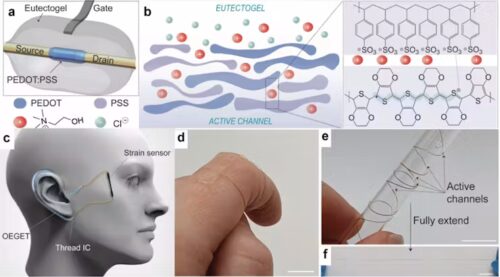
Researchers at Tufts University have developed thread-based electronic circuits that can be sewn into clothing, wrapped around the body, or even used as medical sutures to monitor health without requiring wearable devices such as smartwatches or fitness bands.
Instead of building circuits on flat, flexible sheets, the team created complete analog circuits directly on textile threads. These threads can bend, twist, stretch, and wrap around the body while continuing to work. Each thread can include transistors, resistors, sensors, and amplifiers, allowing the electronics to move naturally with fabric and skin.
The technology uses a gold-coated thread as the electrical wiring. Flexible organic transistors are attached to the thread, while conductive polymer coatings create electrical connections and passive components such as resistors. The researchers also built thread-based sensors that detect stretching, allowing the same thread to sense body movement and process the resulting electrical signals. By combining these components on a single thread, they created analog circuits that amplify small sensor signals without needing a rigid circuit board. A soft material called a eutectogel acts as the transistor’s gate dielectric to control current flow.
Unlike hydrogels, which can dry out over time, eutectogels remain stable without protective coatings while maintaining the ionic conductivity needed for transistor operation. They are also biocompatible and can partially repair themselves. If damaged, the gel can regain its mechanical strength and electrical performance by reconnecting the broken sections and applying gentle heat.
The researchers demonstrated several health-monitoring applications. A thread placed near the temple detected blinking, while another positioned near the diaphragm measured breathing patterns and respiration rate. The technology could also be integrated into everyday clothing, wearable medical devices, or surgical sutures that monitor wound healing. Other possible uses include tracking movement linked to cognitive decline, assessing fall risk in older adults, and monitoring breathing in infants.