

What happens when deterministic embedded workflows meet non-deterministic AI? The answer is reshaping automotive compliance faster than most realise.
This article is based on the talk at EFY Expo Pune 2026, titled ‘Embedded Design & Process Optimisation Using AI Principles,’ featuring a presentation by Sarang Savji, Technical Lead, Varroc Engineering Ltd, India. It has been transcribed and curated by Saba Aafreen, Electronics For You.
The application of artificial intelligence (AI) in embedded systems is emerging as an important area of focus. This is particularly evident in the automotive domain, where complex compliance requirements related to safety, security, and software reliability shape every stage of the development process.
Achieving these compliance requirements involves extensive workflows and process flows that are often time-consuming. At a high level, we can examine how AI and AI-driven tools help simplify these workflows, improve efficiency, and support compliance-oriented development, while extending their impact across embedded development, manufacturing, and production workflows.

Inside the traditional automotive development workflow
This discussion focuses on the existing embedded development workflow and how AI can be integrated not only into development but also into manufacturing and production workflows. We will briefly examine various compliance requirements, understand the high-level differences among AI, ML, and data analytics, and see how these principles can improve process efficiency, design optimisation, and model deployment in automotive embedded systems. We will also touch upon sensor data classification, block-level deployment, and the compliance considerations associated with using AI itself.
The traditional embedded workflow typically starts with requirement analysis, brainstorming sessions, and cross-functional discussions to capture every aspect of the product while ensuring compliance. From there, the process moves through architecture design, hardware and software component selection, firmware development, and integration testing. Alongside this, automotive development also requires strong compliance adherence through standards such as ISO 26262, ASPICE, and cybersecurity frameworks, where traceability, version control, testing, defect analysis, documentation, and risk assessment become critical but highly time-consuming activities.
The manufacturing and deployment workflow follows a similar structure. Once software updates or change requests are received from the production side, developers analyse their impact on requirements, architecture, design and testing before deploying updates to tier-one servers and production plants. Today, much of this process remains manual, including defect fixing, documentation, validation, and release management. This is where AI can play a major role by automating impact analysis, test generation, compliance checks, and workflow optimisation while still keeping human validation in the loop.
At the same time, automotive embedded systems are increasingly driven by three major compliance pillars: ASPICE, functional safety, and cybersecurity. Functional safety focuses on how safely and controllably a system operates under different conditions, while cybersecurity focuses on identifying and mitigating threats when ECUs are connected to networks or receive over-the-air updates. Processes such as HARA for hazard analysis and TARA for threat analysis require different mindsets and extensive documentation. The key question is: How can AI help simplify these complex workflows, improve compliance management, and reduce overall development time?
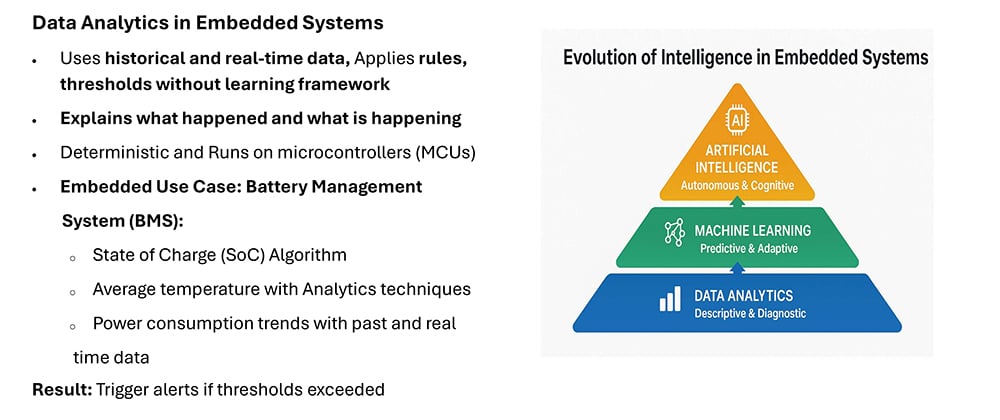
AI vs ML vs Data Analytics: What really matters?
So far, we have examined the compliance requirements and the basic embedded system workflow. Now, we move on to the different principles of AI and how they have evolved over time.