

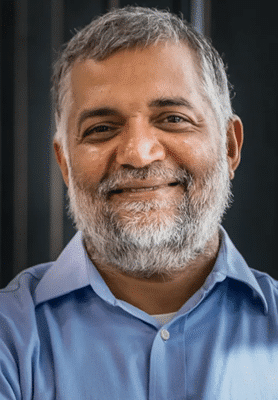
As Texas Instruments marks 40 years in India, Santhosh Kumar, managing director and president, TI India, speaks about the company’s evolution towards end-to-end product development, India-originated innovation, AI at the edge, design-led semiconductor development, and opportunities arising from the country’s growing semiconductor ecosystem. In an interaction with Electronics For You (EFY) at electronica India 2026, he reflects on TI’s journey and examines the role India could play in shaping its next phase.
Q. TI has been in India for 40 years. How have its India operations evolved into a major design and engineering hub?
A. TI’s 40-year journey in India reflects our long-term commitment, with continued investment in local design talent, engineering capabilities and customer engagement. It has been a continuous journey. Today, TI has close to 80,000 products that touch almost every aspect of how we live, move, and work.
TI designs products, manufactures them, and works with customers to help them bring those technologies into their systems. Our team in India contributes significantly to these products. Our teams here work across the product-development cycle, spanning analogue and embedded technologies.
India has always been an important source of engineering talent for TI. We see the country not only as a large and growing market, but also as a place where we can find great engineers, solve complex problems and develop products that have global relevance.
That has translated into several products and innovations being designed and developed in India.
Q. Can you share examples of TI technologies where key innovation has originated from India?
A. There are several examples. Some of the innovative and industry-first products have contributions from the talented engineers at TI India – MSPM0C1104 (the world’s smallest microcontroller), C2000 real-time MCUs, our TinyEngine neural processing unit (NPU) and many more.
If you look at two-wheelers available in India, electronics are becoming increasingly important – from charging systems to microcontrollers. TI technologies are part of many of these applications.
Medical electronics is another good example. Take an ultrasound probe. It can have hundreds of channels that can transmit and receive signals, process that information, and generate an image. We have worked on solutions where much of that processing happens within the probe itself, rather than relying on a connected device.
We work across medical electronics, two-wheelers, smart energy, electric vehicles, appliances, and the power grid.
The grid is also becoming more intelligent. Electronics can help manage how solar energy is received, converted and stored, how it is consumed by homes, factories and offices, and how energy can be fed back into the system when required.
So, the opportunities are broad. Wherever there is an engineering challenge, there is an opportunity for semiconductors to help solve it.
Q. TI describes itself as a company of engineers working with engineers. How does that influence the way it develops products?
A. At TI, we say we are engineers inventing for engineers. That is an important part of who we are. We understand the challenges engineers face because we are solving many of the same problems ourselves. Our collaboration with the Indian Space Research Organization (ISRO) is a great example. TI has supported missions such as Chandrayaan-3, Mangalyaan and NASA-ISRO Synthetic Aperture Radar (NISAR), helping engineers address complex technological challenges.
When we work with customers, we engage at an engineering level. We understand what they are trying to accomplish and can work together to develop solutions for their specific requirements.
For us, engineering is a partnership. It is not simply about developing a product and handing it over to the customer. It is about working together to take an idea from concept to reality.
Q. Where is AI delivering practical value across TI?
A. I look at AI across three aspects.
The first is AI at the edge. TI has products with DSPs, processors, and AI engines that allow intelligence to be brought closer to where data is generated. That means decisions can be made locally rather than always sending data back to the cloud or a server.
This is important for applications such as cameras, radars, speech and other sensing applications, where response time and latency matter.
The second area is how we use AI to make our products and operations better. For example, we use AI in our supply chain to help optimise operations and improve our ability to deliver products to customers.
The third area is manufacturing. We use AI and automation extensively in our factories to improve manufacturing operations.
So, AI is not just something we are putting into products. We are also using it to make the way we operate better.
Q. What makes AI at the edge particularly relevant for embedded systems?
A. When AI processing happens on a remote server, data needs to travel to that server before a decision can be made. That can introduce latency and increase the need for power and connectivity.
With AI at the edge, the intelligence is closer to where the data is generated. You can make decisions locally and in real time. Think about speakers, microphones, cameras or radar. Or even a washing machine that needs to understand its load. In many of these applications, you don’t want to send everything to the cloud just to make a decision. You want the system itself to be intelligent.
We have many examples of TI products that have had a significant contribution from the Indian engineers –from design, development, architecture, testing to manufacturing. That is a great example of the engineering capability we have built in the country.
Q. TI often talks about design-led innovation. What does this mean in practice?
A. I would look at any product through three areas: how you design it, how you manufacture it, and how you sell and support it.
Design-led innovation is particularly important to us because that is how we started our journey in India. From the beginning, our teams here have been focused on design and engineering.
Design is where we start understanding the customer’s real problem. What are they trying to achieve? What innovation is required? And how do you create a product that delivers value for the customer?
Whether it is an ultrasound probe or electronics for two-wheelers, we start with the system-level problem and work backwards to determine what needs to be designed. Some of those innovations become semiconductor products. Others contribute to reference designs and system-level solutions that help our customers develop their products.
India has a significant opportunity to make design an even stronger part of its innovation ecosystem. We need more electronic system designers who can develop reference designs, experiment, optimise, and bring technologies such as Gallium Nitride (GaN) based power solutions into new applications. That is a significant opportunity for India.
Q. What is the biggest gap between an engineering graduate and a design-ready semiconductor engineer?
A. TI continues to nurture the next generation of semiconductor talent through campus hiring and initiatives such as Women in Semiconductors and Hardware (WiSH) program, which is helping encourage more women students to pursue semiconductor careers. Young engineers bring a lot of energy, curiosity and fresh thinking.
Semiconductor engineering is a field where learning never stops. What we were doing 10 years ago may not be what we are doing today. Every month, every quarter, every year, we are learning something new.
The important thing is to give young engineers the right environment, mentorship and opportunities to apply what they have learned.
We see both young and experienced engineers as strengths. Young engineers bring fresh perspectives, while experienced engineers bring the depth that comes from solving complex problems over many years. At TI, the learning journey continues for everyone.
Q. What does India need to do to take greater ownership of global semiconductor products?
A. There are two important aspects: design and deployment. India has the capability to design semiconductors, but the real value is created when those semiconductors become part of a product or system that solves a real-world problem.
For example, a system could use connected sensors and intelligent technology to determine how much water a field needs, improve air quality, increase the efficiency of solar power, or extend the battery life of a two-wheeler.
That is the part we are excited about. The opportunity for India is not just to design a chip. It is to take that chip, combine it with software and system-level engineering, and create a product that solves a problem.
That is where we see a tremendous opportunity to work with the broader ecosystem in India.
Q. After 40 years, where does TI see the biggest opportunity for India over the next decade?
A. We say we are 40 years young in India, because there is still so much opportunity ahead of us. There are significant opportunities across appliances, smarter grids, smart power, and electric mobility. The two-wheeler market is becoming increasingly electrified, creating opportunities for more electronics, sensing, processing and power-management technologies. With close to 80,000 products, it is difficult to identify just one defining opportunity.
For us, the opportunity is wherever engineers are solving important problems, whether that is helping people move more efficiently, use energy more intelligently, improve healthcare or build smarter products.
That is what makes India exciting for TI. There is tremendous engineering talent, a large and growing market, and an ecosystem that is increasingly focused on turning ideas into products.
We want to continue being a partner to those engineers and help them turn those ideas into products that can make a difference in India and around the world.