

India does not just drive differently; it brakes differently. These realities demand adaptive braking solutions, not generic plug-and-play technologies. But how?
This article is based on a session at the Pune Expo 2026 delivered by Rahul Chandrashekar, Vice President, Maxwell Energy Systems. It was transcribed and curated by Sapana Pandya from EFY.
Designing braking systems for India is far more complex than it appears. Chaotic traffic, diverse terrain, extreme weather, and relentless cost pressures force engineers to rethink how vehicles stop and how future braking systems must evolve. India’s roads challenge braking systems like few other environments, making it essential to develop electronics, sensors, and software specifically for local conditions rather than rely solely on global plug-and-play solutions.
Vehicle usage patterns vary widely across the country, making it difficult to design a universal brake-control solution. From two-wheelers navigating congested urban streets to passenger and commercial vehicles travelling across highways, rural roads, and uneven terrain, operating conditions differ dramatically. This diversity makes it clear that a one-size-fits-all approach, particularly for brake-control systems, cannot adequately address the full range of real-world scenarios encountered in India.
Before examining the technology, it is important to understand the nature of the challenge. Mixed vehicle classes, unplanned traffic behaviour, and frequent stop-and-go driving make braking decisions difficult to predict. Add varying levels of dust, humidity, heat, and changing weather conditions, and the challenge becomes even more complex. These factors directly affect braking performance, sensor reliability, and system durability, reinforcing the need to design braking systems with Indian conditions at their core rather than adapting them later.

From mechanical to electronic braking
Braking technology has evolved from wooden brakes in the late 1800s to drum brakes, disc brakes, hydraulic systems, ABS, and today’s electronic braking systems (EBS).
More important than the history itself is the shift in engineering priorities. The transition from mechanical systems to electronically controlled braking has moved the focus beyond simply stopping a vehicle to ensuring safer, more stable, and more comfortable braking. This shift is especially relevant in India, where electronics and software increasingly determine how effectively braking systems respond to unpredictable real-world conditions.
Key challenges in Indian braking systems
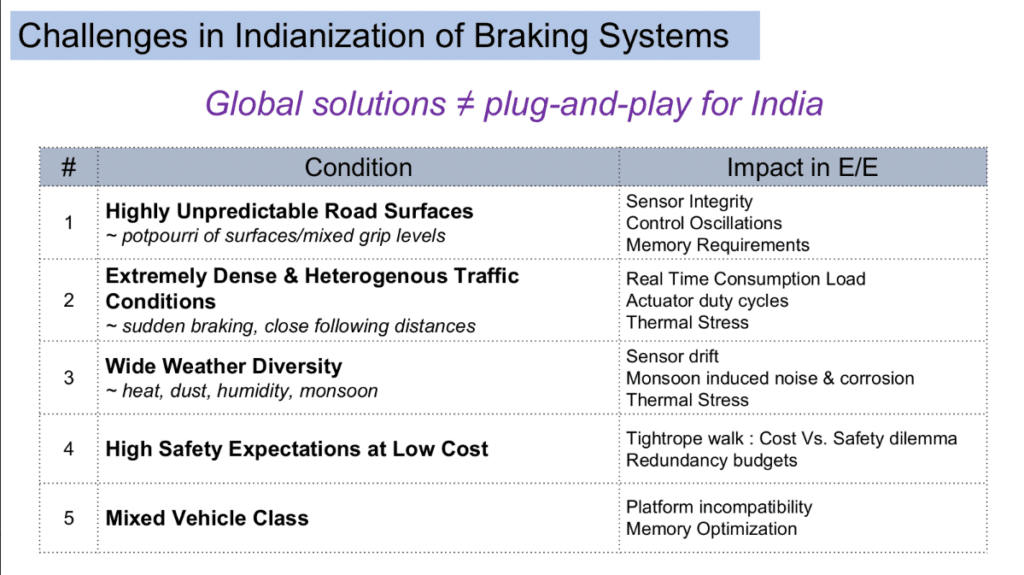
One of the biggest challenges in India is the unpredictability of road surfaces. Conditions can change dramatically even within a single city—from smooth roads to broken stretches and from flat surfaces to hilly terrain. As a result, reliable sensing becomes critical. Sensors must operate accurately despite dust, heat, vibration, and inconsistent traction.
Traffic congestion and unstructured driving behaviour further complicate braking decisions. Drivers often need to brake suddenly because of lane-cutting, pedestrians, mixed traffic movement, or dense stop-and-go conditions. This places greater demands on sensor fidelity and control-system responsiveness.
Weather diversity adds another layer of complexity. Monsoons, dust, humidity, and high temperatures affect sensors, electronics, and braking consistency. Brake heating is also a major concern, particularly under repeated braking in congested traffic conditions.
Cost remains a critical consideration. Engineers must continuously balance safety, performance, and affordability, ensuring that braking technologies remain robust, reliable, and scalable without significantly increasing vehicle costs.
India’s mixed vehicle ecosystem also creates challenges for advanced connected technologies such as vehicle-to-vehicle (V2V) communication. Differences in vehicle classes, communication protocols, hardware platforms, and software architectures complicate interoperability and memory optimisation.
Indianisation of braking electronics
Addressing these challenges requires braking systems to be developed with a clear understanding of Indian operating conditions. The Kano model provides a useful framework by categorising requirements into basic needs, performance needs, and future-oriented features.
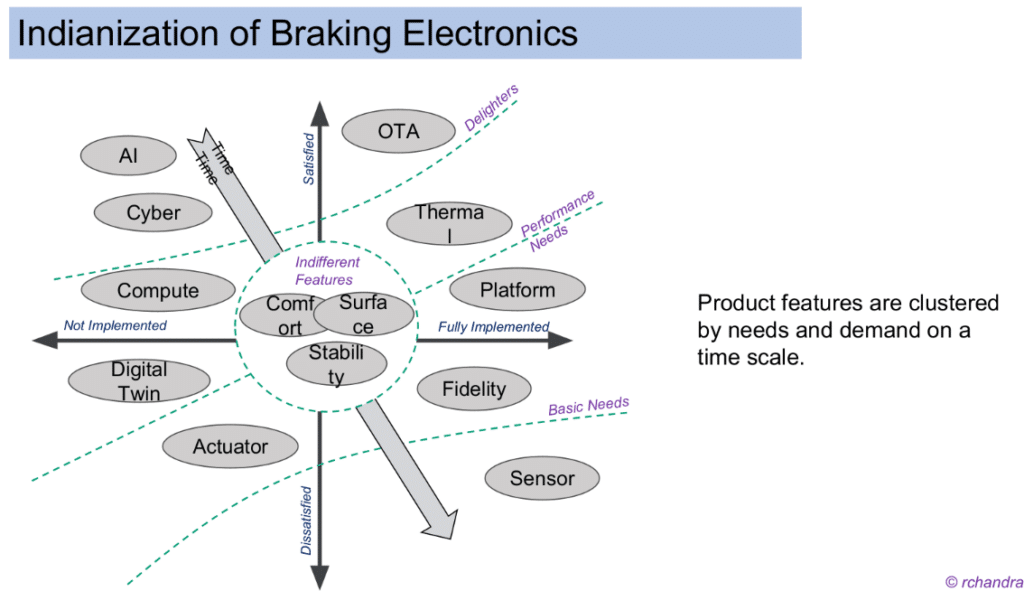
Industry discussions often focus on advanced technologies such as AI, over-the-air (OTA) updates, and automation. While these developments are important, they should not overshadow more immediate priorities. When requirements are force-ranked, sensor robustness and accuracy remain the most critical.
Sensors and actuators form the foundation of braking performance. In India, actuators, particularly motors, often face durability challenges due to environmental and operating conditions. Consequently, reliable sensing and actuation must remain the starting point of system design.
Thermal management is another key performance requirement. As the industry transitions toward electric vehicles and higher-voltage architectures such as 48V and 60V systems, improved thermal insulation and control become increasingly important to prevent overheating.
At the same time, vehicle architectures are moving toward centralised computing and software-defined platforms. The focus here is on optimising memory usage while developing hardware-agnostic solutions that operate across different silicon platforms and vehicle categories.
Stability and rider comfort also remain essential differentiators. A braking system must not only ensure safety but also deliver smooth, predictable, and confidence-inspiring vehicle control.
Technology Waves: Sensing, Power Electronics, and Software
I see three major waves of innovation transforming brake technology in India.
1. Sensing as a critical enabler
Braking decisions are only as effective as the quality of sensor data available. Whether the application involves ABS, traction control, or brake-by-wire, system performance ultimately depends on sensing accuracy.
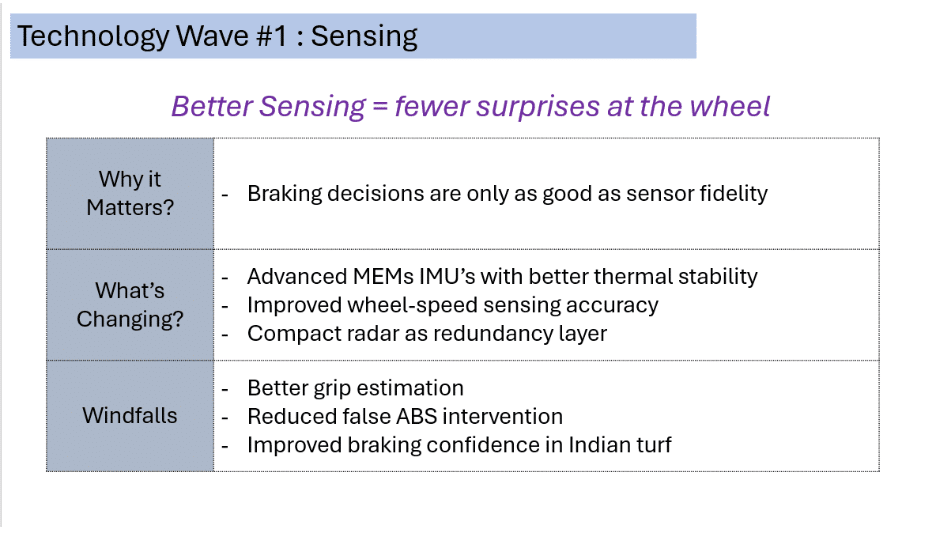
Reliable and cost-effective sensors such as radar, inertial measurement units (IMUs), and wheel-speed sensors are therefore essential. In India, their importance is even greater because irregular terrain and sudden changes in traction can increase instances of false ABS activation. Solving sensing challenges for Indian roads effectively means addressing edge cases that many global markets encounter only occasionally.
2. Efficient power electronics
The second wave is the advancement of power electronics. Moving beyond conventional silicon-based ECUs toward technologies such as silicon carbide can improve both efficiency and thermal performance, particularly in electrified vehicles.
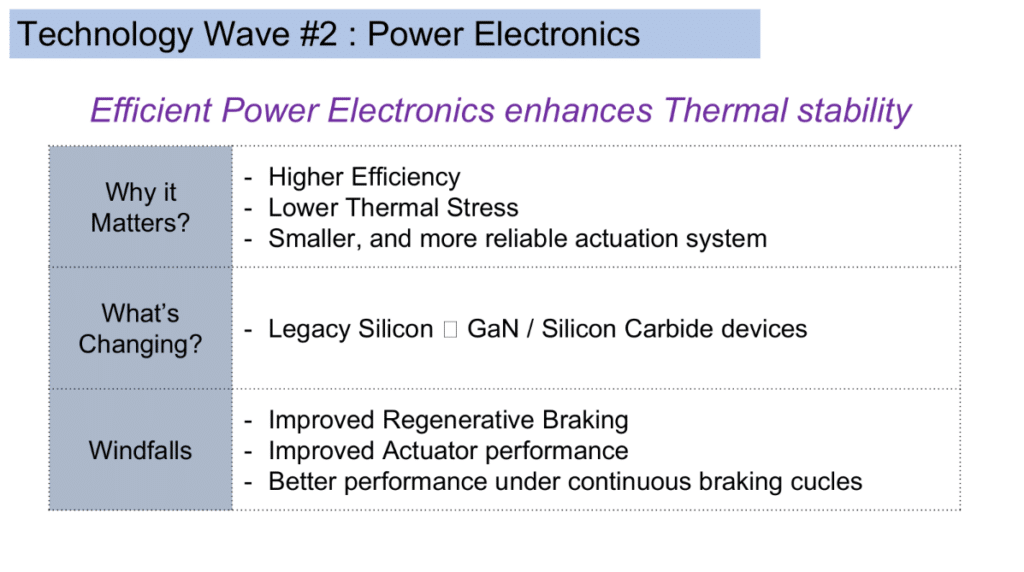
For me, this directly supports the industry’s effort to balance safety, affordability, and future readiness. Improved thermal resilience and energy efficiency can make braking systems safer, more reliable, and better suited to the ongoing EV transition.
3. Software as the transformative layer
The third and most transformative wave is software.
Advanced algorithms, open-source platforms, and hardware-agnostic architectures are enabling centralised computing, improving memory utilisation, and providing greater flexibility across vehicle platforms and hardware ecosystems.
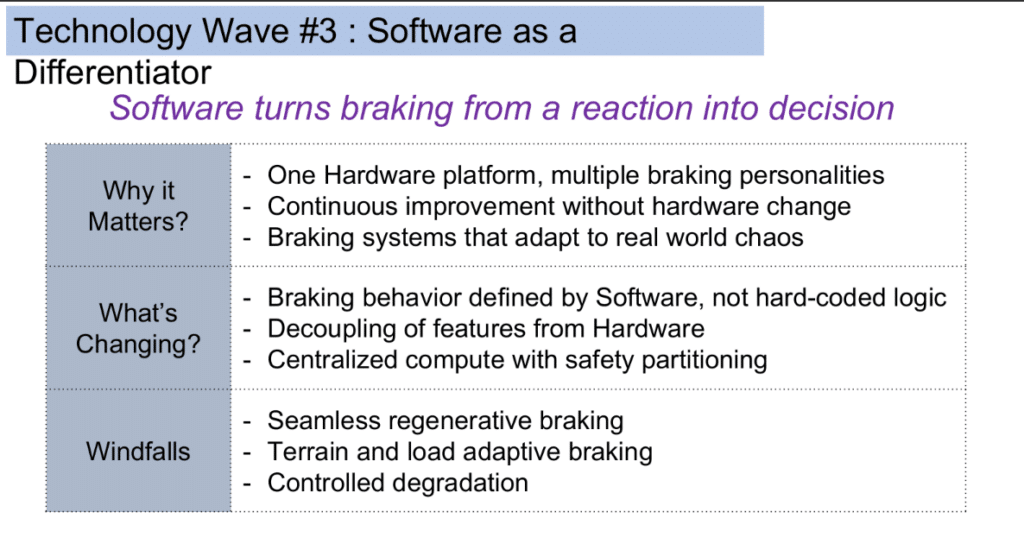
I believe that one of the most practical steps toward Indianisation is software agnosticism. When software remains independent of the underlying silicon and hardware platform, OEMs gain significantly greater flexibility across multiple vehicle architectures.
Digital-twin technology further strengthens this approach. By simulating India’s diverse terrains, weather conditions, and road environments, engineers can validate braking systems far more effectively. Many situations considered edge cases elsewhere are part of everyday driving in India. Designing for these conditions results in systems that are inherently more robust and globally applicable.
The road ahead: autonomy and electrification
As braking technology advances, features such as collision detection, collision avoidance, automated emergency braking, and brake-by-wire are becoming increasingly important.
The transition from manual control toward greater autonomy is likely to be gradual and milestone-driven. In the Indian context, the immediate priority remains the development of solutions that are safe, robust, and cost-effective.
Over the longer term, however, the direction is clear. Advanced braking functions will require more powerful computing capabilities and increasingly sophisticated algorithms within the ECU. As a result, software-defined braking systems will play a growing role in vehicle safety and performance.
Electric vehicles create additional opportunities. With dynamic motors controlling individual wheels, braking can become more precise, responsive, and efficient. Regenerative braking and brake-by-wire technologies can further enhance vehicle control while supporting the broader shift toward software-defined architectures.
The future of braking lies in intelligent, electronics-driven systems that combine robust sensing, efficient power electronics, and advanced software. By addressing challenges related to terrain, climate, cost, vehicle diversity, and mixed traffic conditions, India has the opportunity to develop innovations that are not only effective locally but also globally scalable.
A fundamental reality remains: in India, many edge cases are everyday use cases. Solving braking challenges for Indian roads can therefore lead to systems that are robust by design and relevant worldwide. As electrification and automation continue to accelerate, braking technology will evolve from a mechanical safeguard into a smart, integrated pillar of vehicle safety and performance.