The reference design for automotive gateways combines hardware and software to streamline development and enhance vehicle connectivity.
Automotive gateways are essential in modern vehicles for managing network security and data flow between various electronic control units (ECUs), translating and integrating different communication protocols to ensure seamless operation across diverse systems.
They prioritize bandwidth for critical communications, which is vital with the increasing data demands from systems like ADAS and infotainment. Gateways also facilitate software updates and diagnostics across ECUs, enabling troubleshooting and maintenance while supporting the introduction of new features and services that enhance vehicle functionality and user experience.
These capabilities make automotive gateways central to both vehicle performance and safety. The reference design from Renesas offers a comprehensive development environment, including hardware and software, tailored for automotive gateway applications to accommodate the new E/E architecture.
The design is an automotive communication gateway and offers an integrated DVR/DMS system solution, providing comprehensive functionality for communication gateway applications.
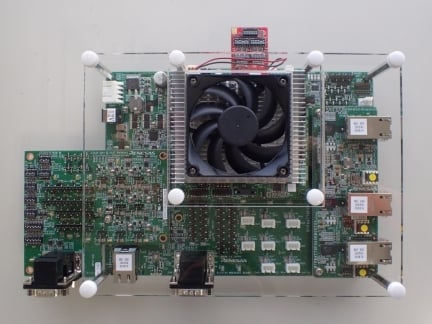
The Spider is a reference board designed explicitly for the R-Car S4 that enables system evaluations and the development of operating systems, device drivers, and applications.
Using the Spider board set facilitates efficient performance assessments of the R-Car S4 system, significantly reducing product development time. The R-Car S4 can be mounted directly or through a dedicated socket on the Spider board set.
The Spider CPU board is equipped with a 512-Mbit HyperFlash memory, 512-Mbit SPI flash memory, and an expansion connector for additional SPI flash memory. These memory units are linked to the R-Car S4’s external flash memory controllers via a bus switch and a switch.
Integrating the MCU core into the R-Car SoC significantly reduces the board size and Bill of Materials (BoM) costs, allowing a single board to control both the MCU and application SoC domains that previously required separate systems.
The reference board comprises a CPU board equipped with the core SoC, a power management IC (PMIC), memory, and an interface board that supports various network types.
The system supports multiple communication protocols, including 16 channels of CAN FD, which can also function as 16 LIN and 8 channels of SENT through multi-function capabilities.
Additionally, it includes 2 channels of FlexRay, 2 channels of PCIe V4.0 x2 lanes, and 3 channels of 5G-USXGMII for Ethernet connectivity. The design is simplified by housing the R-Car S4, LPDDR4x-3200 memory, and HyperFlash memory on the CPU board, contributing to a faster time to market.
Moreover, the combination of pre-regulators and PMICs specifically developed for the R-Car S4 enables the provision of various supply voltages, meeting functional safety requirements up to ASIL D as per ISO 26262 standards. This ensures that the system meets technical performance criteria and adheres to rigorous safety standards.
Renesas has tested this reference design. It comes with a bill of materials (BOM), schematics, assembly drawing, printed circuit board (PCB) layout, and more. The company’s website has additional data about the reference design. To read more about this reference design, click here.