




Fiber-grade optical performance reaches silicon chips, opening new paths for high-speed, energy-efficient electronic systems.
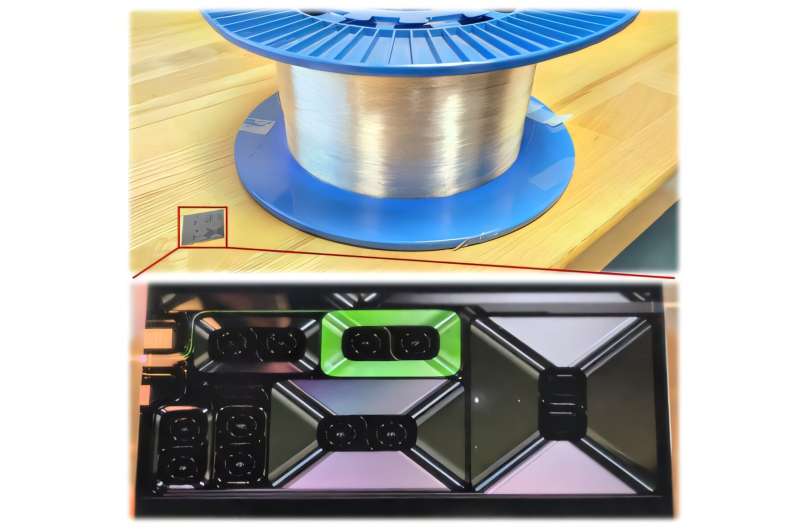
In what could signal a major shift for next-generation electronics, researchers at Caltech have demonstrated photonic circuits on silicon that match the ultralow optical loss traditionally only seen in glass fiber, a milestone for integrated optics and chip-scale electronics.
The heart of the advance lies in a new manufacturing method that adapts the same germano-silicate glass used in optical fiber directly onto silicon wafers. This material has exceptionally smooth, pure surfaces that let light travel with minimal scattering and absorption, the key to achieving fiber-like loss levels on a chip.
Researchers patterned these waveguides in spiral layouts that compact long optical paths onto small chips, preserving performance while reducing footprint. Crucially, the team’s approach works at visible and near-infrared wavelengths, expanding potential uses beyond traditional telecom bands.
Optical fiber has set the bar for loss performance in communications for decades, enabling high-capacity data transport with efficiency no electronic interconnect can match. Bringing that performance to photonic integrated circuits (PICs) could transform how communication and computing electronics transfer information, especially for applications such as AI data centers, precision timing systems, and sensors.
While silicon photonics has steadily improved loss figures over the past years, reaching levels comparable to fiber has been elusive due mainly to fabrication imperfections and material limits. The Caltech team’s use of fiber-standard glass and lithographic fabrication helps overcome those hurdles without sacrificing the scalability of semiconductor manufacturing.
Experts say this work not only boosts coherence and efficiency in photonic components like lasers and resonators but also lays groundwork for optical clocks, gyroscopes, and quantum devices that rely on ultra-low loss light propagation. If further refined and adopted by industry, such low-loss photonic technology promises to blur the lines between traditional fiber networks and on-chip photonics convergence that could reshape the performance and energy footprint of future electronics.


