

With hallucinations, bias, opaque decisions, and even CO₂ costs adding up, it is clear that
AI needs discipline and responsibility built in from the start.
Over the last couple of years, cases of AI causing real-world harm have increased noticeably. It has clearly shown where responsibility truly lies in the AI ecosystem. Responsible AI has become a mandatory compliance layer for enterprise stability. Responsibility has moved from ‘good practice’ to a fundamental design condition.
The hard evidence behind the risk of AI-related harm
Global incident trackers, including the AI Incident Database and the OICT Monitor, now show a marked escalation in AI-related harm. Within a matter of months, incident counts increased from approximately 140,000 to more than 150,000, thereby raising the risk share from around 50 per cent to over 60 per cent. Here goes an expanding set of risks: multimillion-dollar deepfake CEO impersonation scams, ransomware attacks enabled by AI tooling, discriminatory outcomes, unsafe predictions, and privacy breaches. Misuse is now easy, scalable, and cheap.
Even generative video systems show clear, high-visibility bias. In a widely noted example, a model produced only male images when asked about CEOs and only female images when asked about flight attendants. These outcomes are not fringe glitches; they expose structural weaknesses across modern AI systems and mirror what we see in everyday use cases, from loan-approval bots rejecting applicants unfairly to e-commerce customers telling us their AI-first experiences are too costly to scale.
For me, this surge changes the framing entirely. Deepfakes, cyber fraud, biased predictions, privacy breaches, and misuse are operational risks that are affecting consumers, enterprises, and public institutions. The line between digital harm and business harm has effectively disappeared.

The growing trust deficit
AI models continue to struggle with hallucinations and inconsistent predictions.
Healthcare provides some of the clearest evidence. A model incorrectly predicting diabetes for an individual led them to start the wrong medication, with serious consequences. Another model offered flawed medical suggestions that understandably alarmed users. When systems behave this way, trust erodes faster than technical teams can explain what went wrong.
The environmental impact adds another dimension. A single ChatGPT-style prompt produces about 4.32 grams of CO2. That may seem minor, but at enterprise scale, it adds up fast. When millions of queries flow through models running in non-optimised data centres, the emissions rise sharply.
Operating costs also directly correlate with model maintenance and can increase with scalability challenges. The need to maintain constant accuracy in the face of drift and other risks further complicates responsible deployment.
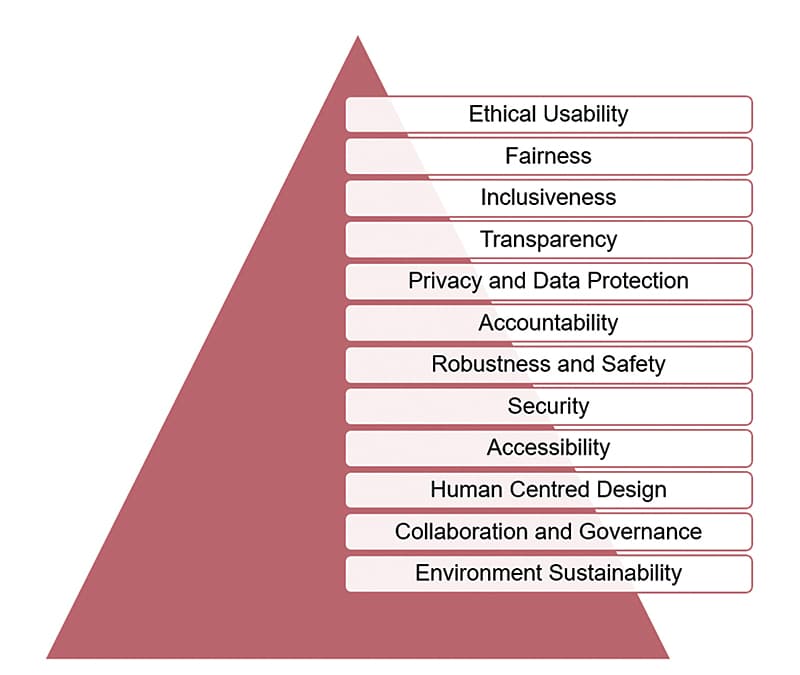
Principles of responsible AI
Principles of responsible AI ensure that AI continues to work equitably across situations and does not dilute results based on users’ different characteristics. Here is a quick look at the principles that I recommend.
Ethical usability
AI applications should be created only for ethical usage.
Fairness
This is where it all starts. AI must treat everyone fairly. It should not favour one group over another. For example, an AI used for hiring should not prefer one gender or community.
Transparency
We must understand how AI arrives at critical decisions.In this regard, explainability tools such as SHAP and LIME exist. Their core function is to explain why a model made a particular choice. They use model cards and training summaries to show the entire workflow by which the AI derived its result.
Privacy
Users should be aware of which of their data is being collected by AI and how that data is used. They can only be in control when they have informed consent and the right to delete any data they are uncomfortable sharing.
Accountability
Every AI system should have a structured reporting and grievance-resolution process with a clearly accountable team or individual. Users should be able to report issues and have them fixed.
Safety
AI must operate reliably even when conditions change. Systems should be tested to handle unexpected situations or manipulations. For example, a chatbot should not provide incorrect advice if someone attempts to confuse it intentionally. Failure analysis and real-world testing help make AI dependable.
Security