A new spectroscopy method explores how electrons inside quantum materials respond to magnetism, uncovering hidden electronic states linked to superconductivity.
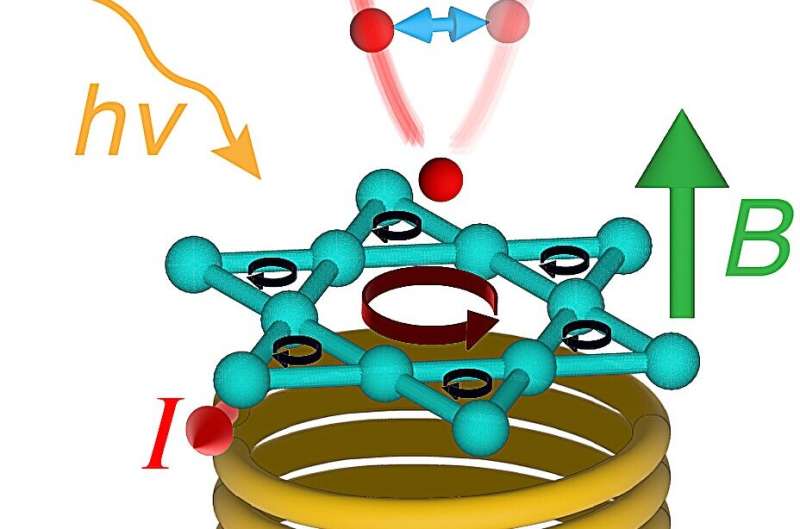
Researchers at Rice University have developed a modified spectroscopy technique that allows scientists to observe previously hidden quantum behavior in superconducting materials. The method, called MagnetoARPES, extends the capabilities of Angle Resolved Photoemission Spectroscopy by introducing a controllable magnetic field during measurements. This addition enables researchers to study how electrons in quantum materials respond to magnetic fields, providing new insights into the electronic behavior that governs superconductivity and other collective states.
Traditional ARPES experiments analyze how electrons move within a material by measuring the energy and momentum of electrons emitted from its surface. However, magnetic fields have generally been avoided in these experiments because they interfere with accurate measurements. The research team developed a way to introduce a small tunable magnetic field generated by a coil while largely preserving the momentum resolved electronic information needed for analysis. This modification allows scientists to probe the electronic response of materials under magnetic influence while still using ARPES to map their electronic structure.
To demonstrate the capability, the researchers studied a kagome superconductor, a class of materials known for unusual electronic structures. By applying the magnetic field during measurements, the team detected collective electron behavior indicating that the material’s quantum state breaks time reversal symmetry. This behavior aligns with theoretical predictions of loop current order, where electrons circulate around the crystal lattice in opposite directions.
The results also revealed a connection between this symmetry breaking and a phenomenon known as a charge density wave, a pattern in which electrons organize into periodic density variations within the material. Observing these relationships may help researchers better understand how such electronic states contribute to superconductivity in complex quantum materials.

Jianwei Huang, researcher at RU says, “Using magneto ARPES allowed us to confirm that kagome’s electrons work together to make the quantum state break time reversal symmetry.”