


A new chip uses terahertz waves to explore materials in ways not possible before, hinting at advancements in science, healthcare, and security research.
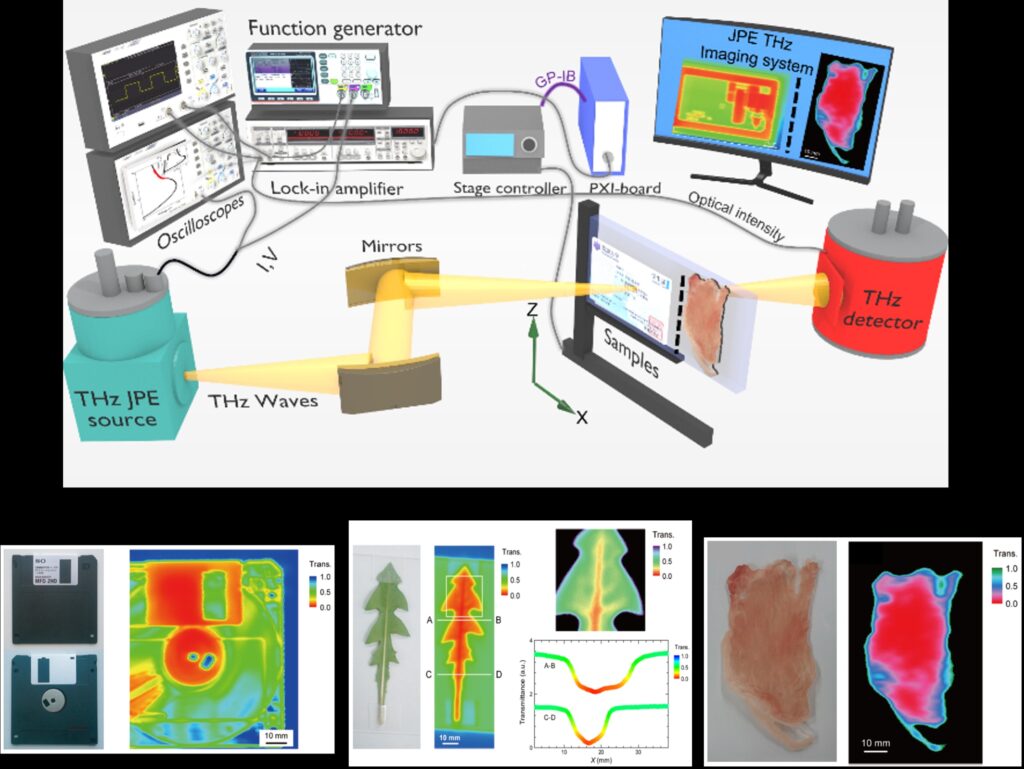
The researchers from the University of Glasgow, the University of Tsukuba and Japan’s National Institute of Advanced Industrial Science and Technology, have developed the lightweight superconducting chip, which they claim could unlock the full potential of terahertz imaging technologies and lead to the development of more powerful and portable devices.
Terahertz radiation lies between the microwave and infrared frequencies of the electromagnetic spectrum. It passes easily and harmlessly through a wide range of materials, and can be used to identify the characteristic ‘fingerprint’ of molecules and biological materials, allowing them to be detected and analysed..
The chip is based around a crystal made from Bismuth Strontium Calcium Copper Oxide, or BSCCO, a high-temperature superconducting quantum material. Its unique structure produces stable and tunable coherent terahertz waves directly on a microchip, enabling compact and energy-efficient imaging systems.
The device’s potential usefulness in security applications is shown by its ability to clearly image surgical blades sealed in a paper envelope and the structural details of a floppy disk. Images of the fine details of the veins inside a dandelion leaf, and the differences between the fatty and leaner areas of a slice of pork, demonstrate how it might be used in environmental monitoring and medical applications.

This capability highlights the potential of the technology for non-invasive material identification through sealed packaging, with promising applications in security screening, pharmaceutical inspection, food quality control, and forensic analysis.
Terahertz radiation is a very powerful tool to enable the imaging and identification of a wide range of materials without harming the samples. Compact terahertz devices could enable fast, non-contact inspection, with potential applications in diagnostics, quality control, and environmental monitoring.