A new magnetic computing device could make future AI systems faster while using less energy and producing less heat than current technology.
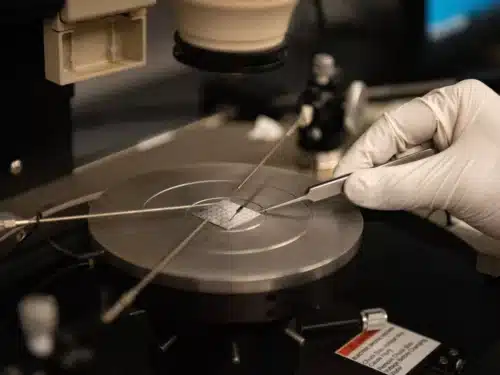
Researchers at the University of Tokyo say they have built a magnetic switching device that operates up to 1,000 times faster than today’s leading AI accelerators while using far less energy and generating minimal heat. The advance could help address some of the biggest problems in modern computing, including overheating, high power consumption, and battery drain in devices ranging from data centers to smartphones.
The prototype uses a type of spintronic technology built from a manganese-tin compound called Mn3Sn, an antiferromagnetic material. Unlike conventional semiconductor electronics, spintronic systems process information using both the electrical charge and the spin of electrons, a method researchers believe could enable faster and more energy-efficient computing.
In laboratory tests, the team switched the material’s magnetic state using a 40-picosecond electrical pulse. A picosecond is one trillionth of a second, or 1,000 times shorter than a nanosecond. According to the researchers, the switching process consumed only a fraction of the energy required by current AI accelerators and produced significantly less resistive heat than conventional computing hardware.
Heat has become a growing constraint in modern processors because faster computing speeds typically require more power and generate more thermal output. That challenge has increased energy demands for data centers and limited performance gains in consumer electronics.
The researchers say the technology could eventually support applications such as low-power AI systems, energy-efficient cloud infrastructure, and quantum computing services if it can be scaled for commercial manufacturing.
Professor Tomo Nakatsuji of the University of Tokyo said the technology could dramatically reduce processing times for some computing tasks, potentially turning operations that currently take an hour into tasks completed in seconds.
The team also cautioned that faster magnetic switching alone would not automatically make entire computers 1,000 times faster. Overall computing performance still depends on other hardware and software bottlenecks throughout a system.