


Researchers reveal how tiny metallic dendrites sabotage solid-state batteries and uncover a path to safer, energy-dense power for advancing devices.
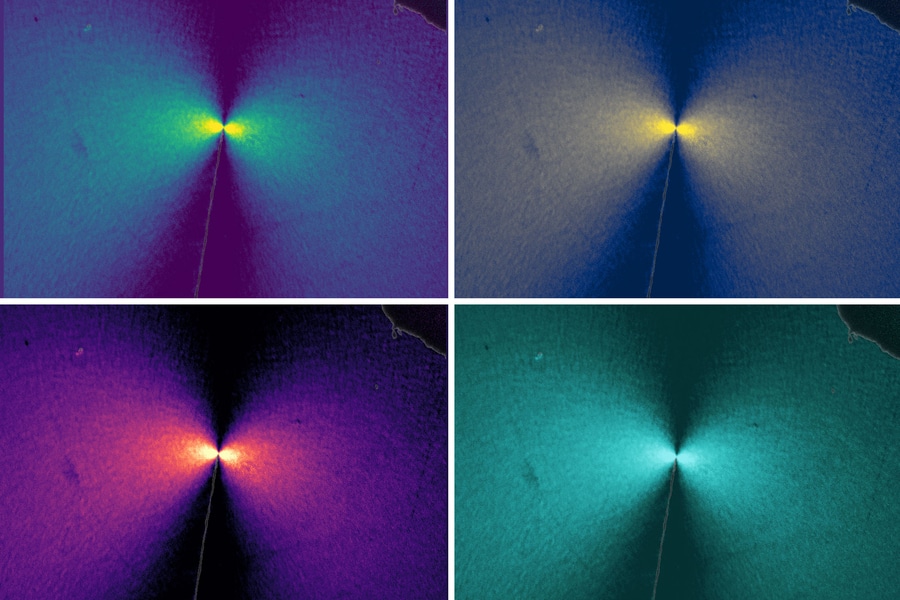
MIT researchers have uncovered why solid-state batteries, long hailed as safer and more energy-dense alternatives to lithium-ion, are prone to short-circuiting. Using a novel visualization technique, the team directly observed metallic dendrites growing through the electrolyte, revealing mechanisms that challenge decades of assumptions about mechanical stress being the primary cause.
At the system level, these insights explain why simply making stronger electrolytes hasn’t solved the dendrite problem. The study shows that during charging, chemical reactions triggered by ionic currents weaken the solid electrolyte, causing it to fracture at stress levels as low as a quarter of what would be expected under mechanical stress alone. This embrittlement occurs even in highly stable electrolytes, limiting energy density and safety in devices ranging from phones to electric vehicles.
From a design perspective, the findings emphasize the importance of chemically robust materials. By revealing the interplay of mechanical and chemical effects in dendrite formation, engineers can now target electrolytes that resist electrochemical degradation while maintaining structural integrity. This approach could enable longer-lasting, higher-capacity solid-state batteries.
Technically, the researchers employed birefringence microscopy and cryogenic scanning transmission electron microscopy to quantify stress around actively growing dendrites at near-atomic scales. They observed that faster dendrite growth corresponded to lower stress, counter to prior expectations. This provides actionable guidance for developing electrolytes that remain tough under operational conditions, rather than just in static lab tests.
“Direct measurement techniques allowed us to see how tough the material is as we cycle the cell,” says Cole Fincher, MIT PhD student and first author. “What we saw was that if you just test the ceramic electrolyte on the benchtop, it’s about as tough as your tooth. But during charging, it gets a lot weaker — closer to the brittleness of a lollipop.”