Scientists at Nottingham Trent University (NTU) have developed a smart pillow sleeve that uses vibrations to alert deaf individuals to fire alarms, burglar alarms, and phone calls during the night. Created in collaboration with members of the Deaf community, the innovation is designed to replace bulky devices placed under pillows—devices many users find uncomfortable and disruptive to sleep.
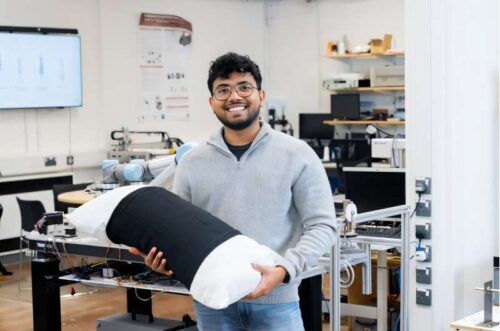
The solution features a slim, flexible electronic textile sleeve that fits over a standard pillow and sits inside a regular pillowcase. Embedded within the fabric are four tiny haptic actuators, each measuring just 3.4 mm by 12.7 mm. These components are integrated into a yarn-like structure, making them virtually unnoticeable to the user. When the pillow is placed on a bed, the sensors are positioned at the bottom.
The sleeve connects to a smartphone via a microcontroller, which can wirelessly link to household alarm systems. Different vibration patterns are used to distinguish between alerts, such as fire alarms, burglar alarms, or incoming calls.
Ph.D. researcher Malindu Ehelagasthenna, who led the project as part of his doctoral work at the Nottingham School of Art & Design, explained that the idea emerged directly from user feedback. Members of the Deaf community reported difficulty sleeping with traditional alert devices under their pillows. He noted that the embedded electronics are so small they cannot be felt, yet they can produce strong vibrations capable of waking even deep sleepers.
The textile has undergone extensive durability testing, including repeated washing cycles, to ensure it can withstand everyday use. The research team is now refining the prototype and seeking industry partners to help bring the product to market.

Dr. Theo Hughes-Riley, who supervised the work and is part of NTU’s Advanced Textiles Research Group, emphasized that the design marks an important step toward more inclusive safety solutions. He highlighted that the project was entirely shaped by user input, addressing real challenges identified by the Deaf community and demonstrating how electronic textiles can improve both safety and comfort.