What if cameras could see through darkness, fog, and smoke at lower cost? A new infrared sensor design could make that possible.
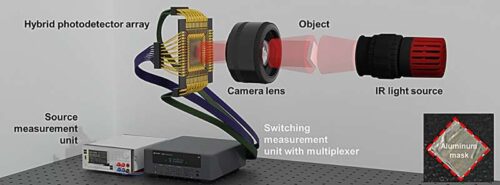
A research team from Daegu Gyeongbuk Institute of Science and Technology, working with collaborators at the Korea Institute of Science and Technology and the Korea Institute of Materials Science, has developed a low-cost infrared sensor capable of detecting extremely weak short-wave infrared (SWIR) signals with high sensitivity. The device achieves a responsivity of 7.5 × 10⁵ A/W and a detectivity on the order of 10⁹ Jones, and has been demonstrated in a 32 × 32 pixel imaging array.
The study, published in Advanced Materials, addresses a key limitation of conventional SWIR sensors, which rely on expensive materials such as indium gallium arsenide (InGaAs). These materials increase fabrication costs and make it difficult to scale devices to large-area applications.
To overcome this, the researchers designed a hybrid photosensor that combines Ag₂Te quantum dots—known for strong light absorption—with a MoS₂ two-dimensional semiconductor that enables fast charge transport. This approach allows each material to compensate for the other’s limitations, improving overall device performance.
A photodoping effect at the interface between the two materials plays a central role in boosting performance, amplifying the electrical signal generated under illumination and enabling detection of very weak infrared signals.

The team also demonstrated practical applicability by fabricating a 32 × 32 pixel infrared sensor array, confirming that the technology can capture real images rather than just operate as a single device.
Because the sensor is compatible with conventional CMOS semiconductor processes, it shows strong potential for large-scale manufacturing as a low-cost, large-area SWIR imaging solution.
SWIR sensors are useful for detecting objects not only in daylight and darkness but also in conditions such as fog or smoke, making them relevant for applications including autonomous systems, robotics, surveillance, and medical imaging.