




Researchers demonstrate DNA-based electronic memory controlled by metal ions, enabling read-write-erase functions on a chip and opening pathways for ultra-dense, low-power molecular data storage systems.
A team of researchers at New York University has demonstrated a DNA-based electronic memory system that can store, process, and retrieve data, marking a step toward integrating biological molecules directly into electronic hardware.
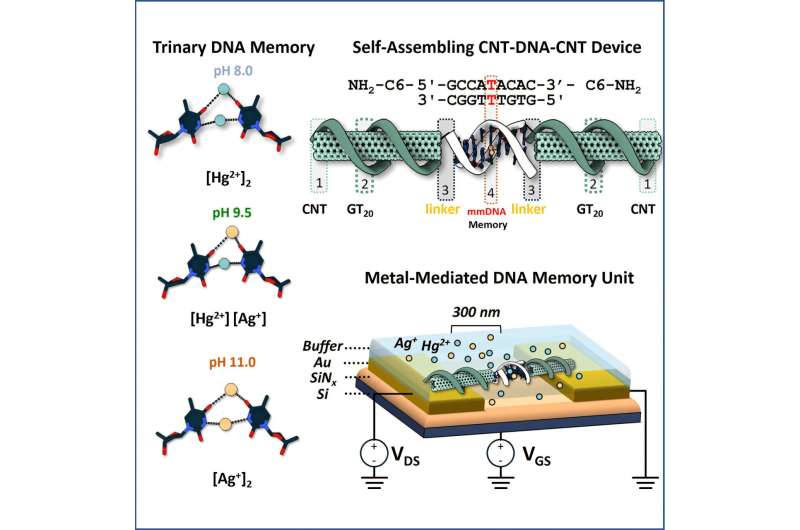
The study, led by scientists at New York University and Arizona State University, shows that a single DNA strand can function as an electronic switch when combined with metal ions and connected to a microchip. This enables the DNA to act not just as storage, but as an active component in electronic circuits. The advancement hinges on controlling metal ions embedded within the DNA structure. By adjusting pH levels, researchers were able to swap mercury ions with silver ions inside the DNA double helix. This exchange alters the molecule’s electrical conductivity effectively switching it between different electronic states.
When integrated with molecular leads and a chip, these conductivity changes translate into measurable electrical signals. This allows the system to perform core memory functions, including writing, reading, and erasing digital information similar to conventional semiconductor memory, but at a molecular scale. Unlike traditional silicon-based memory, which relies on charge storage in transistors, this approach embeds computation and storage directly within the DNA structure. The result is a highly compact system that could significantly increase data density while reducing energy consumption.
Researchers describe the system as an early version of a “DNA transistor,” pointing to future possibilities where biological molecules are integrated into nanoelectronic architectures. Such systems could blur the boundary between chemistry and electronics, enabling new forms of computing hardware. One of the major challenges in DNA data storage has been efficient data retrieval. By introducing electrical control, the new method provides a direct interface between molecular storage and electronic readout, potentially overcoming this limitation.
The work is still at an experimental stage, but it highlights a broader shift toward molecular electronics, where information processing occurs at the scale of atoms and molecules. If scalable, DNA-based memory could complement or even extend beyond silicon technologies, offering ultra-dense storage and new architectures for low-power computing in future electronic systems.


