

An explainable AI system that predicts potential runway collision risks using real airport data, offering faster warnings and improved aviation safety for increasingly crowded airspace environments.
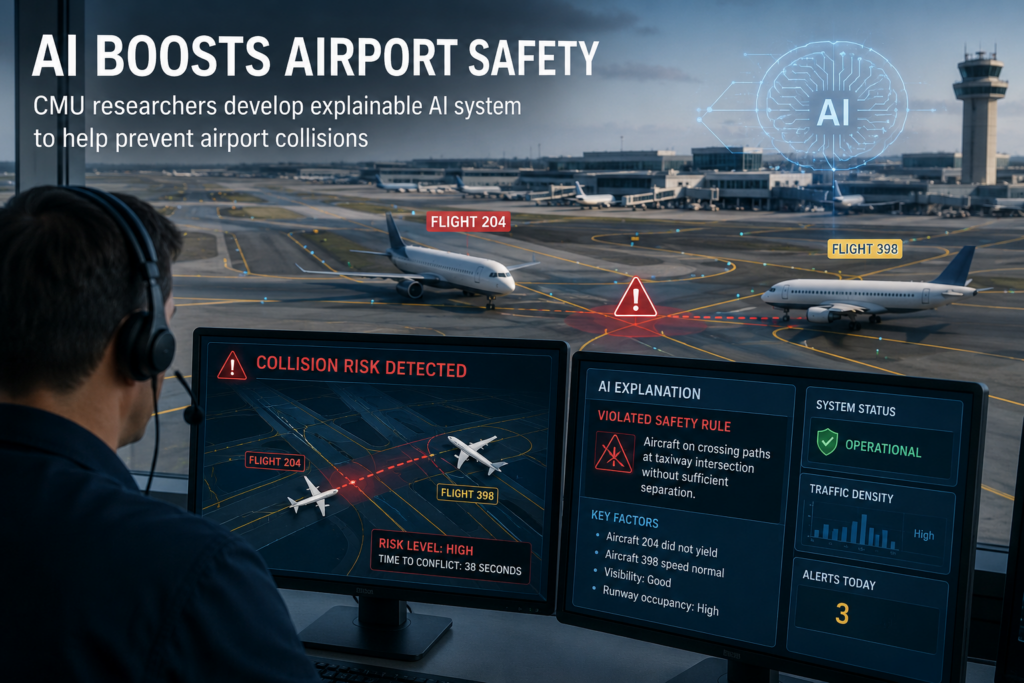
As air traffic density continues to rise, researchers at Carnegie Mellon University have developed an artificial intelligence system designed to identify and explain potential airport collision risks before they escalate into dangerous incidents. The technology, called World2Rules, aims to strengthen aviation safety by predicting risky aircraft behaviour and giving operators additional reaction time.
The system was developed in response to increasing concerns over runway incursions and near-miss events at airports worldwide. Unlike traditional monitoring systems that primarily generate alerts, the new AI platform attempts to explain why a situation could become dangerous. Researchers say that interpretability is critical in safety-sensitive environments where operators need to understand the reasoning behind system recommendations rather than relying on opaque predictions.
World2Rules uses a neuro-symbolic AI framework that combines machine-learning capabilities with human-readable logic rules. The system learns from real airport operations data and historical incident records to distinguish between normal traffic behavior and potentially unsafe patterns. When a risk is detected, the AI identifies the violated safety rule and explains the reasoning in operational terms instead of issuing a generic warning.
To train and validate the system, researchers used data from the Amelia-42 dataset, a large repository containing airport surface movement information collected across dozens of U.S. airports. The project also relied on high-performance computing resources to process and analyze the massive volume of aviation data required for model development.
The development arrives as aviation systems face growing pressure from increasing passenger traffic, autonomous aircraft research, drone integration, and complex airport operations. Rather than replacing existing prediction tools, researchers envision World2Rules functioning alongside current safety systems as an additional intelligence layer.
Beyond airport operations, the research team believes the same explainable AI architecture could eventually support safety monitoring in other high-risk domains such as autonomous transportation, robotics, and industrial automation.