A high-speed microcomb-enabled wireless link operating in the terahertz spectrum, potentially advancing next-generation electronics, 6G infrastructure, and ultra-fast data communication systems.
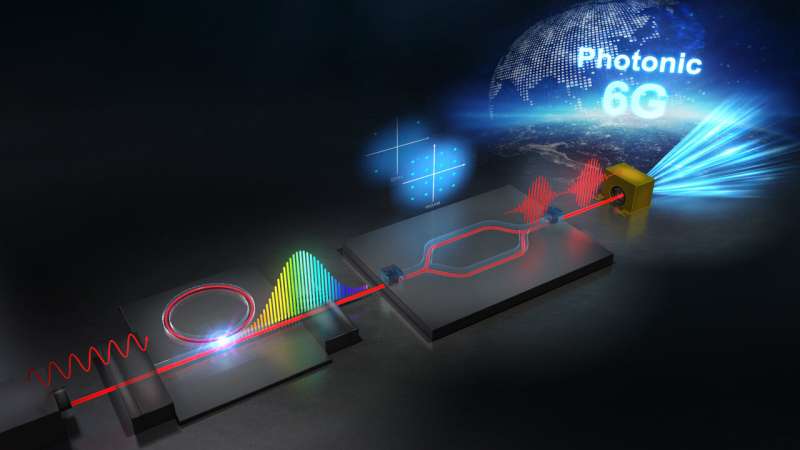
Researchers at Tokushima University have demonstrated a breakthrough in ultra-high-speed wireless communication using microcomb technology, pushing wireless transmission deeper into the terahertz (THz) spectrum and opening new possibilities for future electronics and 6G systems. The development addresses a growing challenge facing communication infrastructure: moving exponentially increasing volumes of data without relying solely on conventional radio spectrum resources.
The newly demonstrated system achieved wireless transmission rates exceeding 100 Gbps while operating in the 560 GHz band. This marks an important shift because current wireless systems are approaching spectrum limitations as data-intensive applications such as AI computing, cloud services, immersive technologies, and connected devices continue to expand. THz frequencies are viewed as one of the next frontiers for high-capacity communications because they can carry significantly more information than traditional microwave bands.
At the core of the technology are optical microcombs—chip-scale devices capable of generating multiple precisely spaced optical frequencies from a single light source. Often described as optical rulers, these devices simplify complex photonic architectures while enabling extremely high bandwidth. Their compact size also makes them attractive for integration into electronic and communication systems.
Unlike traditional systems that require multiple laser sources and increasingly complicated hardware designs, microcomb-based architectures can reduce system complexity while supporting very high data rates. Researchers believe such devices could eventually become foundational components in future wireless electronics platforms, particularly where high throughput and lower power requirements are critical.
The implications extend beyond faster mobile networks. Future applications could include high-speed data center interconnects, smart factories, autonomous systems, extended reality platforms, and satellite communication links. As researchers continue improving transmission range and reliability, microcomb-driven THz communication may emerge as a key technology supporting next-generation electronic ecosystems.