


A Li-Fi (light fidelity)-based optical communication system is designed to transmit digital data as light signals using a laser diode and a photodiode. Unlike conventional RF communication systems, the design employs on-off keying (OOK) modulation, in which the presence of light represents a logic high (1) and the absence of light represents a logic low (0). The transmitted information is organised into data packets containing headers, payload, and checksum fields, enabling the reliable transfer of various file types over a free-space optical link at baud rates of up to 260kbps.
This system demonstrates high-speed optical wireless communication with serial data transmission and signal conditioning, using a laser diode, a BPW34 photodiode, and an LM393 comparator. It also highlights key communication concepts, including synchronisation, noise reduction, high-speed switching, and error detection in practical communication systems.
POC Video Tutorial
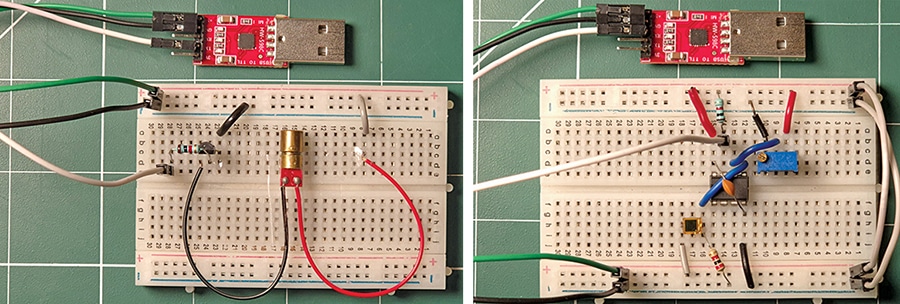
The technique can be adapted for smartphones and other portable devices, enabling high-speed file transfer using the built-in camera flash LEDs and optical sensors, at speeds significantly higher than many traditional wireless methods. Fig. 1 shows the author’s breadboard prototype of the transmitter (L) and receiver (R) units.
Circuit and working
The system comprises two main sections: a Li-Fi laser transmitter circuit and a Li-Fi optical receiver circuit.
Fig. 2 shows the circuit diagram of the Li-Fi laser transmitter. It is built around a CH9102 USB-to-UART converter module (U2), BC547 NPN transistor (T1), and a laser diode (LD1). Both power and serial data are obtained directly from the USB interface through the CH9102 module, making the circuit suitable for direct connection to a PC or laptop USB port.