




A battery liquid helps key reactions occur more easily, improving performance and bringing fluoride-based batteries closer to energy storage applications.
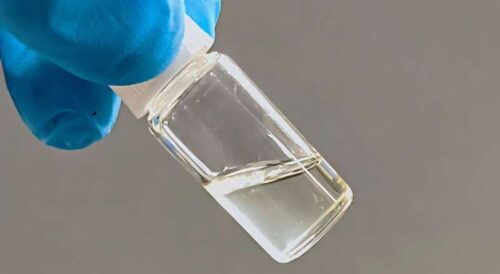
Researchers from Japan’s Institute for Molecular Science and Thailand’s Khon Kaen University have developed a new electrolyte for fluoride shuttle batteries that enables reversible fluorination and defluorination reactions using potassium tetrafluoroborate (KBF4), a low-cost and chemically stable inorganic salt. The breakthrough, reported in ACS Applied Energy Materials, offers a simpler route to improving the performance of fluoride shuttle batteries, a technology being explored as a potential alternative to lithium-ion batteries.
In laboratory tests, the KBF4-based electrolyte demonstrated high electrochemical stability and supported reversible reactions in bismuth-based electrodes. The researchers found that fluorination occurred at a significantly lower potential than in previous systems that relied on organic additives, indicating that KBF4 influences fluoride ion activity and electrode reactions through a different mechanism.
Fluoride shuttle batteries have attracted attention because they can theoretically deliver high energy density while using abundant and inexpensive materials. These batteries store and release energy by moving fluoride ions between electrodes. However, their development has been limited by the difficulty of triggering the fluorination reaction, which often leads to unwanted side reactions and performance loss.
To address this challenge, the research team investigated KBF4, a fluorine-containing inorganic salt known for its chemical stability. The researchers proposed that KBF4 could regulate fluorination reactions at the electrode-electrolyte interface while also improving fluoride ion availability in the electrolyte.
Experiments showed that adding KBF4 together with cesium fluoride (CsF) to a tetraglyme-based electrolyte significantly increased the concentration of dissolved cesium ions, suggesting improved fluoride salt solubility and changes in the state of fluoride ions within the electrolyte.
Further analysis using cyclic voltammetry and X-ray photoelectron spectroscopy confirmed reversible fluorination and defluorination reactions on a bismuth electrode. Charge-discharge testing also demonstrated reversible operation in a bismuth fluoride composite electrode, confirming the electrolyte’s ability to support the key reactions required for fluoride shuttle batteries.
The findings introduce a new electrolyte design strategy that avoids the need for complex organic additives. As research continues on electrolyte optimization, electrode design, and battery stability, the approach could help advance the practical development of fluoride shuttle batteries for future energy storage applications.

