

A millimetre-wave transceiver that doubles spectrum efficiency while eliminating self-interference, paving the way for faster, lower-latency wireless networks for future 5G Advanced and 6G applications.
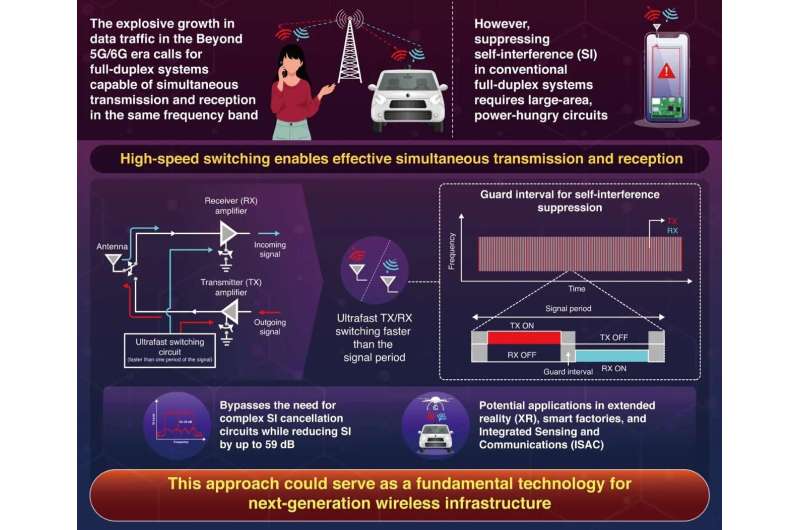
A team of researchers at the Institute of Science, Tokyo, has unveiled a millimetre-wave transceiver architecture that could significantly improve wireless network capacity by enabling simultaneous transmission and reception on the same frequency channel. The breakthrough addresses one of the most persistent challenges in full-duplex wireless communications—self-interference—and could help accelerate the development of Beyond 5G and 6G networks.
The newly developed transceiver operates in the 24–28 GHz millimetre-wave band and uses an innovative time-division switching technique that alternates between transmitting and receiving at a rate faster than the wireless signal period. By isolating self-interference in the time domain rather than relying on complex cancellation circuits, the design achieves simultaneous communication while reducing hardware complexity and power consumption.
Full-duplex communication has long been viewed as a key technology for future wireless systems because it allows devices to send and receive data concurrently on the same frequency. In theory, this can double spectrum utilisation compared with traditional half-duplex systems. However, practical implementation has been limited by signal leakage from the transmitter to the receiver, which often overwhelms the incoming signal. Existing solutions typically require dedicated interference-cancellation circuitry, increasing chip area, design complexity and energy usage.
Experimental testing demonstrated self-interference suppression ranging from 42 dB to 59 dB across a 400 MHz-wide millimetre-wave signal, a bandwidth compatible with advanced 5G deployments. The researchers implemented the architecture using standard 65 nm CMOS technology, highlighting its potential for commercial scalability and integration into future wireless infrastructure.
The development comes as demand for high-capacity wireless connectivity continues to grow. Emerging applications such as artificial intelligence, extended reality (XR), autonomous systems and smart factories require ultra-fast, low-latency communication links capable of handling massive volumes of data. Millimetre-wave technologies are increasingly viewed as critical enablers of these services because of their large available bandwidth and ability to support multi-gigabit data rates.
Industry analysts expect millimetre-wave technology adoption to expand rapidly over the next decade as telecom operators invest in next-generation wireless infrastructure. Advances in transceiver design, beamforming and spectrum efficiency are expected to play a central role in meeting future network capacity requirements while controlling power consumption and deployment costs.