This Indian startup is making edge AI hardware more accessible, equipping developers to build faster, smarter machines without high costs or reliance on the cloud.
Building hardware is often difficult for people with strong ideas but limited resources. Tools are expensive, ecosystems are fragmented, and turning concepts into real products can feel out of reach. Akshar Vastarpara, coming from a software background, saw that innovation was slowed less by talent and more by a lack of access. He believed hardware should be as approachable as software and founded Vicharak to make it easier, faster, and more accessible to build. ‘Vicharak,’ meaning someone who thinks, reflects the company’s vision of computation as a tool to think, process, and create.
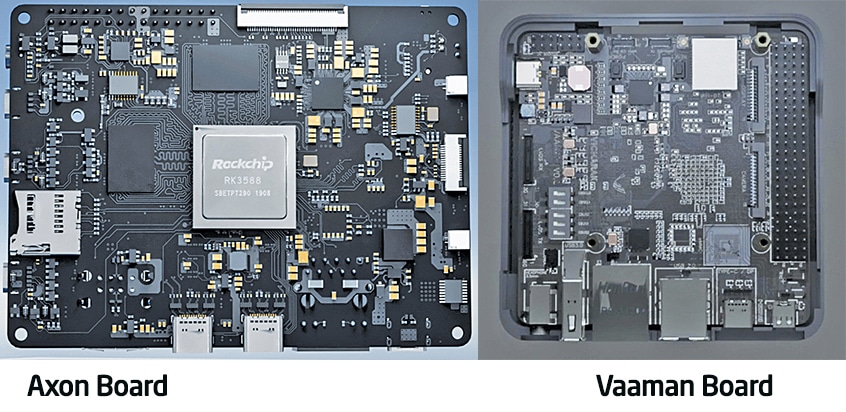
Vicharak builds edge-computing hardware for AI applications, focusing on single-board computers comparable to Raspberry Pi and Nvidia Jetson platforms, but with built-in AI acceleration and stronger developer support. The goal is to enable physical AI systems, such as robots, drones, and industrial machines, to process data on-device rather than relying on the cloud, thereby improving speed and efficiency. Its main board, Axon, is an all-in-one platform with a processor, memory, storage, connectivity, and motor-control pins, allowing developers to directly connect sensors and build applications.
While Raspberry Pi is widely used, modern edge AI applications demand more compute power. Akshar explains, “While Raspberry Pi revolutionised the market by focusing on hobbyists, education, and lightweight edge computing, its hardware still comes with limitations for modern AI-heavy workloads. Our Axon board addresses this gap with higher-performance processors, dedicated AI acceleration, support for multiple camera streams, richer storage, and expanded sensor and display interfaces for more demanding edge applications.”
Beyond Axon, Vicharak launched the Shrike-lite board, a unique fusion of an Arduino-style development experience with FPGA capabilities. Designed for beginners, students, and early-stage engineers, Shrike-lite lowers the barrier to entering electronics, computation, and chip design.

Another major product line is Vaaman. Unlike traditional single-board computers, Vaaman combines a Linux-capable compute platform with FPGA technology in a single compact form factor, enabling users to experiment with much higher-performance, hardware-accelerated computing than standard boards can offer.

Talking about the design challenges faced in developing these boards, Akshar adds, “When we started building early platforms like Vaaman with a 10-layer PCB and later moved to Axon with a 12-layer design, we were stepping into a level of complexity we didn’t fully understand yet. As we pushed towards 14-layer, 16-layer, and eventually HDI-class boards, the biggest realisation was that we were often designing without knowing what we didn’t know. Critical concepts such as RAM-to-CPU routing, high-speed signal integrity, and power distribution networks weren’t part of our initial thinking—they had to be learned along the way through online resources, courses, and continuous experimentation.”
For manufacturing, the startup currently relies on a contract facility in Baroda, near Surat, as it does not yet have its own SMT pick-and-place line. However, there is a clear plan to establish an in-house manufacturing setup within the next four months, beginning with the Shrike series and then gradually expanding production capacity for Axon and Vaaman over the following year. The company continues to handle component sourcing, debugging, testing, firmware flashing, and final validation independently, while packaging is also managed internally. As a result, only about 30% of the overall process is outsourced, with the remaining 70% retained and controlled in-house.
When asked about the current challenges the company is facing and addressing, Akshar discloses, “Hardware startups in India face a funding gap compared to D2C and product companies, which makes early growth difficult even with strong ideas. There is also a talent gap—not in numbers, but in training for real hardware development, where engineers need more hands-on experience to build, test, and learn from real systems. At the same time, India has a huge base of software developers, and the real opportunity lies in giving them simple, accessible platforms to move into hardware and edge computing.”
Talking about the revenue generated by the company, Akshar says, “We were at a very pre-revenue stage for the last two years, during which we primarily sold beta kits and onboarded users onto the Vicharak platform. During this phase, we sold around 500 Axon units, nearly 100 Vaaman boards, and over 5000 Shrike-lite units. With a growing order pipeline and planned production expansion, we are targeting sales of at least 10,000 Axon and Vaaman units combined, along with around 50,000 Shrike-series units in the coming cycle.”