A carbon material can host multiple superconducting states, with some remaining active in magnetic fields, helping researchers study new quantum effects.
Researchers at Massachusetts Institute of Technology have discovered that a naturally occurring graphite structure can support multiple superconducting states, revealing new electronic behavior in one of the most common carbon materials. The findings, published in Nature, could improve understanding of unconventional superconductivity and guide future quantum material research.
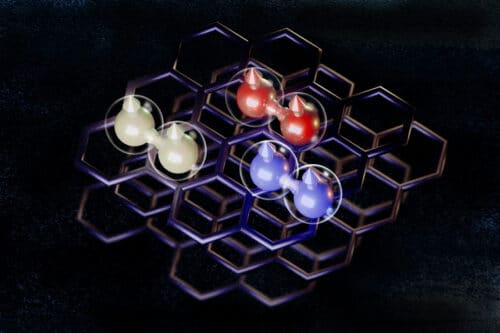
The team studied rhombohedral graphene, a natural arrangement of four or five graphene layers found inside graphite. By changing the number of electrons in the material and applying magnetic fields, they observed four different superconducting states. Three of these states continued to function even under strong magnetic fields, while one became stronger when exposed to a magnetic field.
To perform the study, the researchers first isolated rhombohedral graphene from natural graphite by exfoliating graphite into atomically thin layers. They then adjusted the electron density in the samples while measuring electrical resistance under ultracold temperatures and strong magnetic fields.
At specific electron densities, the researchers identified four superconducting states. Three remained stable in magnetic fields of up to about 9 tesla when the field was applied parallel to the graphene layers. When the magnetic field was applied perpendicular to the layers, one superconducting state not only survived but also operated at a higher temperature than expected.

The researchers found that the superconducting transition temperature increased from about 55 millikelvin to nearly 90 millikelvin under these conditions. The material also carried around 50–60% more current before losing its superconducting properties.
The team believes the unusual behavior may result from electrons pairing with aligned spins rather than opposite spins, as seen in conventional superconductors. If confirmed, this mechanism could explain why superconductivity survives or even strengthens in magnetic fields. However, the researchers note that further experimental and theoretical studies are needed to verify this explanation.
The discovery highlights the potential of naturally occurring graphite structures as platforms for studying unconventional superconductivity and other quantum phenomena. By controlling electron density and magnetic fields, researchers can access multiple electronic states within the same carbon-based material.